Why it returns every time treatment stops, the different patterns and why the dry scaly type gets mistaken for dry skin, why the skin between the toes matters so much for anyone with diabetes, how long to keep treating after it looks better, and what to do about shoes and socks.
Stephanie Tine diagnoses and treats athlete's foot in Fort Lauderdale, from the first visit through recovery.
Why does it come back every time I stop treating it?
Because you are almost certainly treating one part of a system and leaving the rest of it alone.
The organisms that cause athlete's foot are dermatophytes, a family of fungi that feed on keratin, the protein in skin, hair, and nails. The same family causes ringworm on the body, jock itch in the groin, and toenail fungus. They are not different problems with different causes. They are the same organisms in different places on the same person, and they move between those places freely.
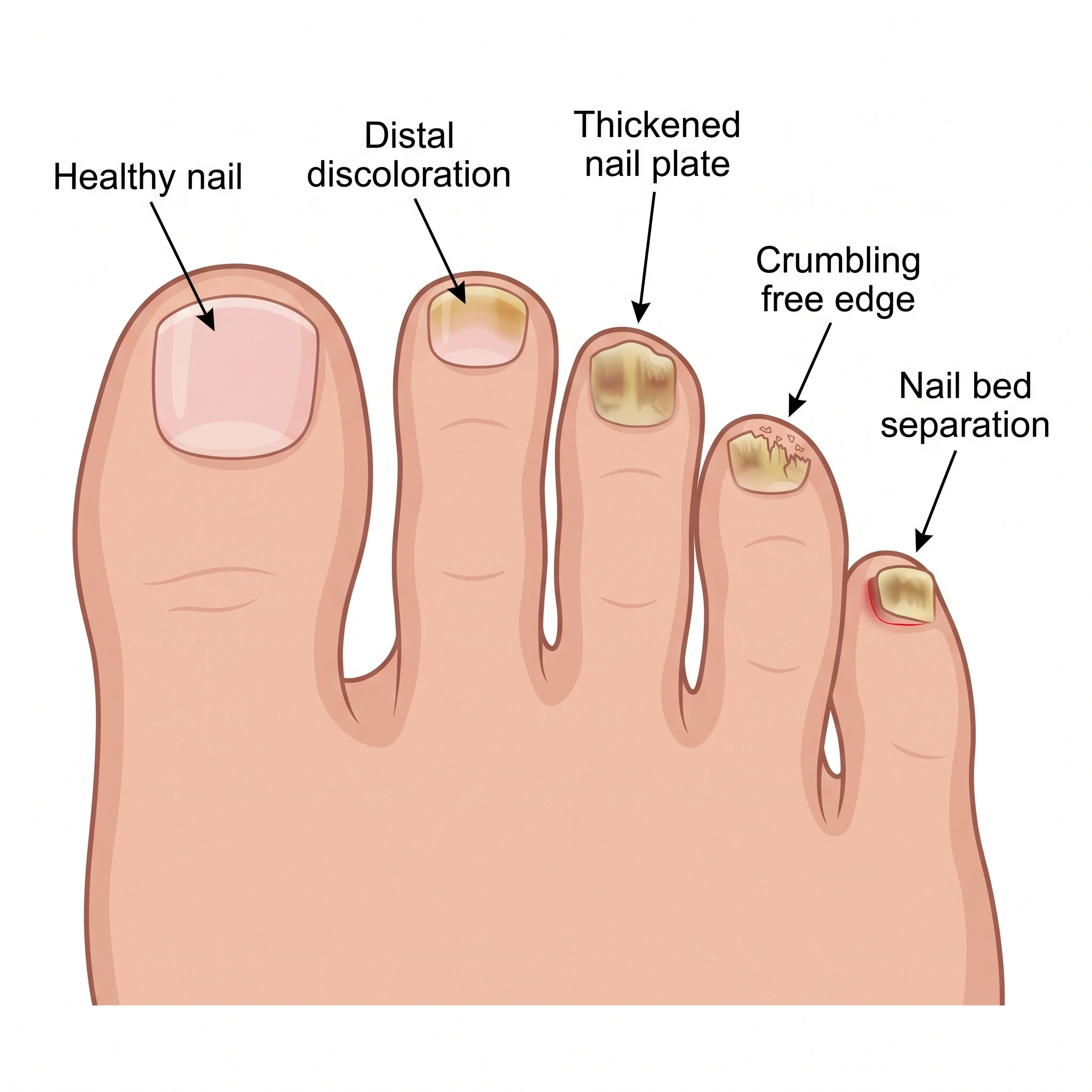
That is why the single most common reason athlete's foot returns is an untreated fungal toenail. A nail is a fortress: the cream you rub on the skin does not penetrate it, so the nail sits there as a permanent reservoir, shedding organisms onto the skin every day. You clear the skin, you stop the cream, and within weeks the nail has reseeded it. Anyone whose athlete's foot keeps returning should have their nails examined, and anyone being treated for nail fungus should be treated for skin infection at the same time.
The shoes are the second reservoir. Spores survive in the lining and insole, and a shoe worn daily never dries out. The third is the rest of the household, particularly a shared bathroom floor where one untreated person keeps reseeding everyone else.
There is a pattern worth knowing that gives this away: two feet and one hand. When someone has fungal infection on both feet and on one hand, it is usually the hand they use to pick at or apply cream to their feet.
What are the different patterns, and which one do I have?
Athlete's foot does not have one appearance, and knowing the patterns explains why so many cases go unrecognized for years.
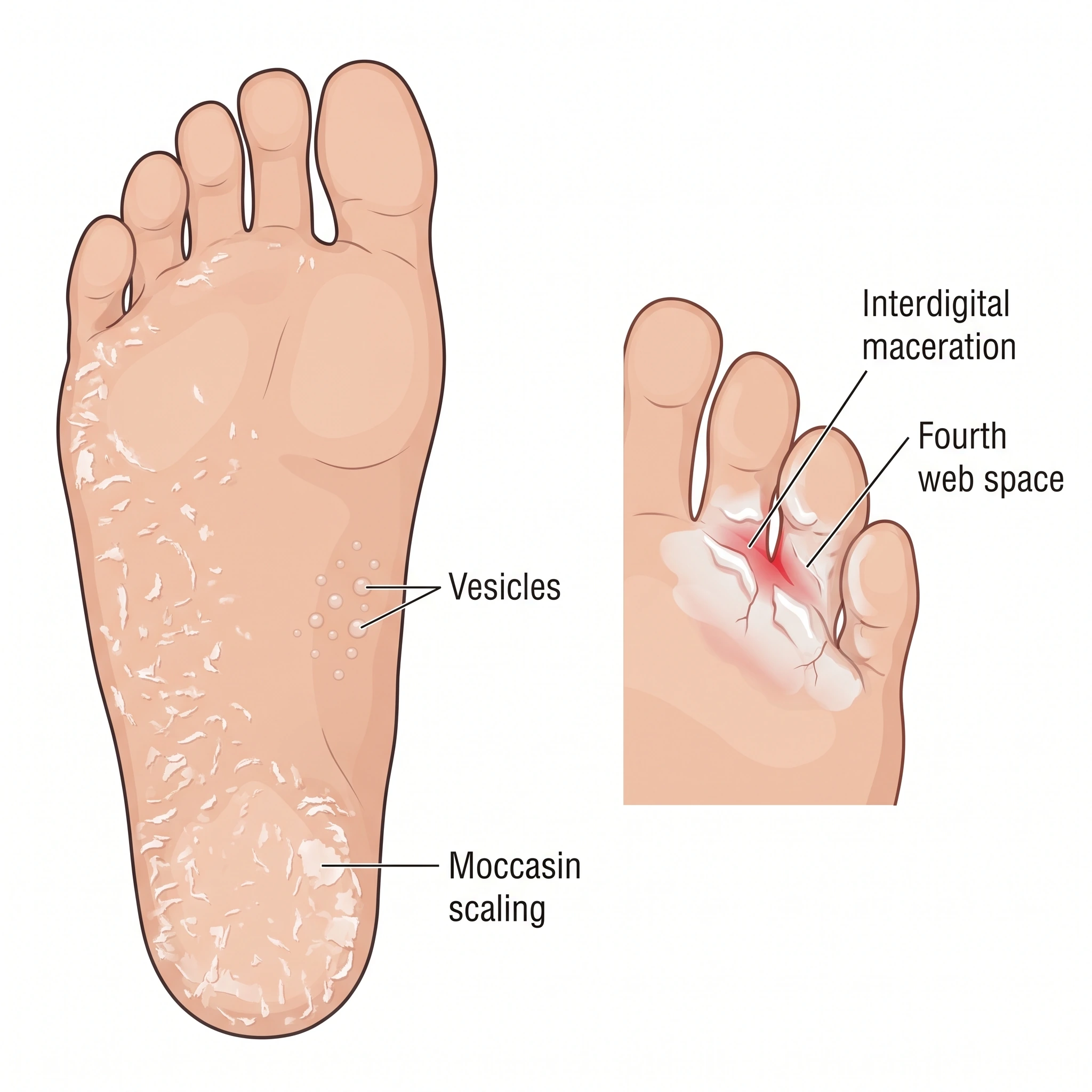
The interdigital pattern is the familiar one. It sits between the toes, most often in the outermost web space between the fourth and fifth toes, where the gap is narrowest and stays dampest. The skin is white, soggy, and peeling, sometimes with a crack at the base of the toes, and it itches. This is the type people recognize and treat.
The moccasin pattern covers the sole, the heel, and the sides of the foot in a fine, dry, silvery scale, stopping in a fairly sharp line where the sole meets the top of the foot, roughly where a moccasin would end. It usually affects both feet, it often comes with thickened toenails, and it frequently does not itch much at all. People describe it as dry skin and treat it with moisturizer for years.
The vesicular pattern is sudden. Small fluid-filled blisters appear, usually on the arch or the instep, often in a cluster, and it is intensely itchy. It tends to flare and settle.
The ulcerative pattern is the one to take seriously. Web spaces that have broken down into raw, macerated, sometimes foul-smelling erosions usually mean bacteria have joined the fungus.
A page cannot tell you which of these you have, and more than one can be present on the same foot.
Why do people mistake the dry, scaly type for dry skin?
Because it genuinely looks like dry skin, it does not behave like an infection, and the usual clue is missing.
Ordinary dry skin is itchy, rough, and improves with moisturizer. Moccasin-type athlete's foot is often not itchy, which removes the symptom most people associate with fungus. It is chronic and slowly progressive rather than flaring, so there is no obvious moment when something started. And moisturizer does help the surface feel better, which is exactly the wrong feedback: it softens the scale without touching the organism, so the person concludes the diagnosis was correct and continues for years.
There are giveaways. The border is the most reliable one. Dry skin fades out gradually; moccasin tinea tends to stop in a defined line along the side of the foot. The scale is fine and white and sits in the skin creases, giving a dusty look. It is usually on both feet and has usually been there a long time. And it very often travels with thickened, discolored toenails, which is the strongest hint of all, because that is the reservoir keeping it going.
The practical consequence is that this type usually needs more than a two-week cream. Because it covers a large area of thick sole skin, and because the nails are usually involved, prescription topical treatment for a longer course or oral antifungal medicine is more often required. It is also the type most worth confirming with a skin scraping before committing, since psoriasis and chronic eczema of the sole can look very similar.
Why does the skin between my toes matter so much if I have diabetes?
Because a macerated web space is an open door, and in a foot with diabetes the door leads somewhere worse.
Intact skin is the barrier that keeps bacteria out. Athlete's foot breaks that barrier: the soggy skin between the toes splits, and the fissure is often too small and too hidden to notice. Bacteria that live harmlessly on the skin surface get underneath it. Cellulitis of the lower leg, a spreading bacterial infection, very commonly starts at exactly this spot, and treating the fungus is part of preventing it from recurring.
Three things stack on top of each other in a foot with diabetes. Peripheral neuropathy means the crack may not be felt at all, so it is not noticed until something visible happens. Reduced circulation means less blood, fewer immune cells, and slower healing at the exact tissue that needs to heal. And elevated blood glucose impairs how well white cells work. A problem that is trivial in another foot is not trivial here, and a web space fissure can become a foot ulcer.
The practical instructions are short. Look between every pair of toes every day, using a mirror or another person if you cannot see them. Dry between the toes carefully after washing. Do not put moisturizer between the toes, because keeping that space damp is exactly the wrong move even though the skin elsewhere on the foot needs it. And treat athlete's foot early and properly rather than waiting to see whether it settles. See diabetic foot care for how these checks fit into a routine.
How long do I keep treating after it looks better?
Longer than feels necessary, and this is the single most useful instruction on the page.
The itching and redness settle well before the organism is gone. What you see is your skin's reaction to the infection, and that reaction quiets down early. The dermatophyte is still living in the outer layer, which takes weeks to shed and replace itself. Stopping when the skin looks normal is stopping partway, and the visible infection returns from what was left behind.
For the common web-space type treated with an over-the-counter cream, the general rule is to use it for the full duration on the label, commonly two to four weeks, and to continue for one to two weeks after the skin looks and feels normal. Read the specific product, because the required course varies between ingredients. The American Podiatric Medical Association advises completing the full course of treatment rather than stopping at symptom relief. These are ranges, not promises.
Moccasin-type infection needs longer, often several weeks of a prescription topical over the whole sole, and often oral medicine because of the area involved and the nails that usually come with it.
Treat the whole area, not the patch. That means both feet even if only one looks affected, the whole sole rather than just the visible scale, and every web space rather than the one that itches. A patch that is left alone reinfects the rest, and that is how a four-week course turns into a four-year problem.
What should I be doing to my shoes and socks?
Treating the foot and returning it to a contaminated, damp shoe is the most common way good treatment is wasted.
Rotate shoes so no pair is worn two days running. A shoe worn daily never dries, and the inside of a closed shoe after a day of wear is warm, dark, and humid, which is precisely what the organism needs. Pull removable insoles out overnight so both dry. Antifungal powder or spray used inside the shoes, not only on the feet, reduces the load.
Socks matter more than people credit. Cotton holds moisture against the skin; moisture-wicking synthetic or wool blends move it away. Change them when they are damp rather than by the clock, which for many people means a second change midday. Wash socks, towels, and bath mats in hot water.
Dry properly. Most people dry the sole and skip the toes. Use a separate towel for the feet, dry each web space individually, and if the spaces stay damp, a hair dryer on a cool setting for a few seconds works well. Some people find a thin gauze or foam separator between the toes overnight helps.
Wear sandals on shared wet floors: locker rooms, gym showers, pool decks, and hotel bathrooms. And do not walk barefoot through your own house if someone in it is being treated, because a bathroom floor is a shared wet floor too.
When is it not athlete's foot at all?
Several conditions imitate it well enough that treating the wrong one for months is common.
Dyshidrotic eczema produces itchy blisters on the sides of the fingers and toes and on the arch, looking very much like the vesicular pattern. Contact dermatitis from shoe materials, particularly rubber accelerators and adhesives, produces redness and scaling on the top of the foot in the shape of the shoe, sparing the web spaces. Psoriasis on the sole makes thick, well-defined red plaques with silvery scale, and it often appears elsewhere on the body too.
Two bacterial look-alikes belong here. Pitted keratolysis makes shallow, punched-out pits in the sole of a sweaty foot with a strong smell, and it responds to antibacterial rather than antifungal treatment. Erythrasma makes a reddish-brown patch in a web space that does not respond to antifungal cream.
In children, juvenile plantar dermatosis produces shiny, red, cracked skin over the weight-bearing part of the sole, sparing the web spaces, and it is not fungal at all.
One warning is worth its own line. A steroid cream applied to fungal infection reduces the redness and itch while letting the organism spread, producing a strange, poorly defined rash that is harder to recognize and harder to treat. It has a name, tinea incognito. If a rash is being treated with a steroid cream and is spreading or changing shape, stop and have it examined rather than continuing.

Can it spread to other parts of my body or to other people?
Yes on both counts, and understanding how changes what you do.
On your own body, the usual route is your own hands. Scratching the feet and then touching the groin transfers the organism, which is why jock itch and athlete's foot so often appear in the same person. Pulling underwear on over infected feet does the same thing, which is why the standard advice is socks first, then underwear. Infection can also settle on a hand, on the body as a ring-shaped patch, or in the toenails, which then becomes the reservoir discussed earlier.
Between people, it travels on floors, towels, bath mats, and shared shoes. It does not require direct contact with an infected foot; walking barefoot where an infected foot has been is enough, and warm damp floors keep spores viable. This is why a household tends to pass it around and why treating one person while another goes untreated rarely holds.
Some people are simply more susceptible. Feet that sweat heavily, occupations in boots, a warm climate, older age, diabetes, and a weakened immune system all raise the risk, and some of it is inherited susceptibility that nothing changes.
None of this makes athlete's foot dangerous for a healthy person. It makes it persistent, and persistence is beaten by treating everywhere it lives at once rather than one place at a time.
What are the treatment options?
- 01Wash and dry the feet daily, especially between the toes, and change socks whenever they aWash and dry the feet daily, especially between the toes, and change socks whenever they are damp
- 02Alternate shoes so each pair dries fully, and use an antifungal powder or spray inside theAlternate shoes so each pair dries fully, and use an antifungal powder or spray inside them
- 03Over-the-counter antifungal cream, spray, or powder, applied over the whole area for the fOver-the-counter antifungal cream, spray, or powder, applied over the whole area for the full course on the label
- 04Confirmation with a skin scraping when the diagnosis is uncertain or the skin is not respoConfirmation with a skin scraping when the diagnosis is uncertain or the skin is not responding
- 05Prescription topical antifungal medicine for infection that has not cleared or that coversPrescription topical antifungal medicine for infection that has not cleared or that covers the sole
- 06Treatment of any fungal toenails at the same time, since they reinfect the skinTreatment of any fungal toenails at the same time, since they reinfect the skin
- 07Oral antifungal medicine for moccasin-type, blistering, or widespread infection, or when tOral antifungal medicine for moccasin-type, blistering, or widespread infection, or when topical treatment has failed
- 08Antibiotics in addition when bacteria have infected broken-down skinAntibiotics in addition when bacteria have infected broken-down skin
What do patients ask most?
Do I have to throw out my shoes?+
Can I use a steroid cream for the itching?+
Is athlete's foot why my feet smell?+
Can children get athlete's foot?+
Does everyone in the house need to be treated?+
Trained at Adventist Health White Memorial, Los Angeles (three-year foot and ankle surgical residency, Chief Resident). Sees patients in Fort Lauderdale.
About Dr. Tine →