Why a toe starts bending without any injury, what flexible and rigid mean and why that single distinction drives every treatment choice, what the corn on top and the callus under the ball of the foot are telling you, what surgery involves, and what can slow it down without surgery.
Stephanie Tine diagnoses and treats hammertoe / claw & mallet toe in Fort Lauderdale, from the first visit through recovery.
Why is my toe bending when I never injured it?
Every small toe is balanced by a tug of war.
Long tendons from the calf pull the toe down from underneath and up from on top. Small muscles inside the foot itself, running from the sole to the sides of the toes, hold the base of the toe down against the ground so the long tendons can do their job cleanly. When the small muscles lose that argument, the long tendons win, and the toe buckles at its middle joint.
The most common reason they lose is length. If the second toe is longer than the big toe, a very common foot shape, it hits the end of the shoe first and has nowhere to go but up and over. Over years of stepping, that toe learns a bent position and keeps it.
A bunion does the same thing from the side. As the big toe drifts toward the second, it steals the second toe's space and pushes it into a bent, crowded position. This is why a bunion and a hammertoe so often appear on the same foot, and why treating one without looking at the other misses the point.
Shoes are the third contributor. A toe box that is shallow, narrow, or short bends the toe every time you take a step, and a raised heel slides the whole foot forward into that toe box. Shoes rarely create the problem on their own, but they take a toe that was inclined to buckle and make it buckle sooner.
What does it mean that my toe is flexible or rigid?
This is the single distinction that drives every treatment decision, and it is settled in about five seconds in the office.
The examiner pushes up on the ball of the foot under the bent toe, or simply straightens the toe with a finger. If the toe comes straight, it is flexible. If it will not come straight, it is rigid.
A flexible toe means the joint surfaces and the capsule around them are still normal. The deformity lives in the pull of the tendons, and the position is one the toe can still be talked out of. Padding, stretching, and shoe changes work here. When surgery is chosen for a flexible toe, it is soft tissue surgery: releasing or lengthening the tendon on top, releasing the tight tissue at the base of the toe, and sometimes rerouting the tendon underneath so it pulls the toe down instead of curling it.
A rigid toe means the soft tissues around the joint have tightened and shortened, and the joint surfaces themselves may have worn. No amount of stretching will change the position, because the block is structural. Correcting a rigid toe means taking out or fusing the joint, which is bone surgery.
In between sits the semi-rigid toe, which straightens partway and then stops. These are the interesting ones, because they can go either way, and they are the reason to be seen sooner rather than later. A flexible toe has more options than a rigid one, and toes generally move in one direction over time.
Why do I have a corn on top of my toe and a callus under the ball of my foot?
Because they are telling you two different things, and both are useful.
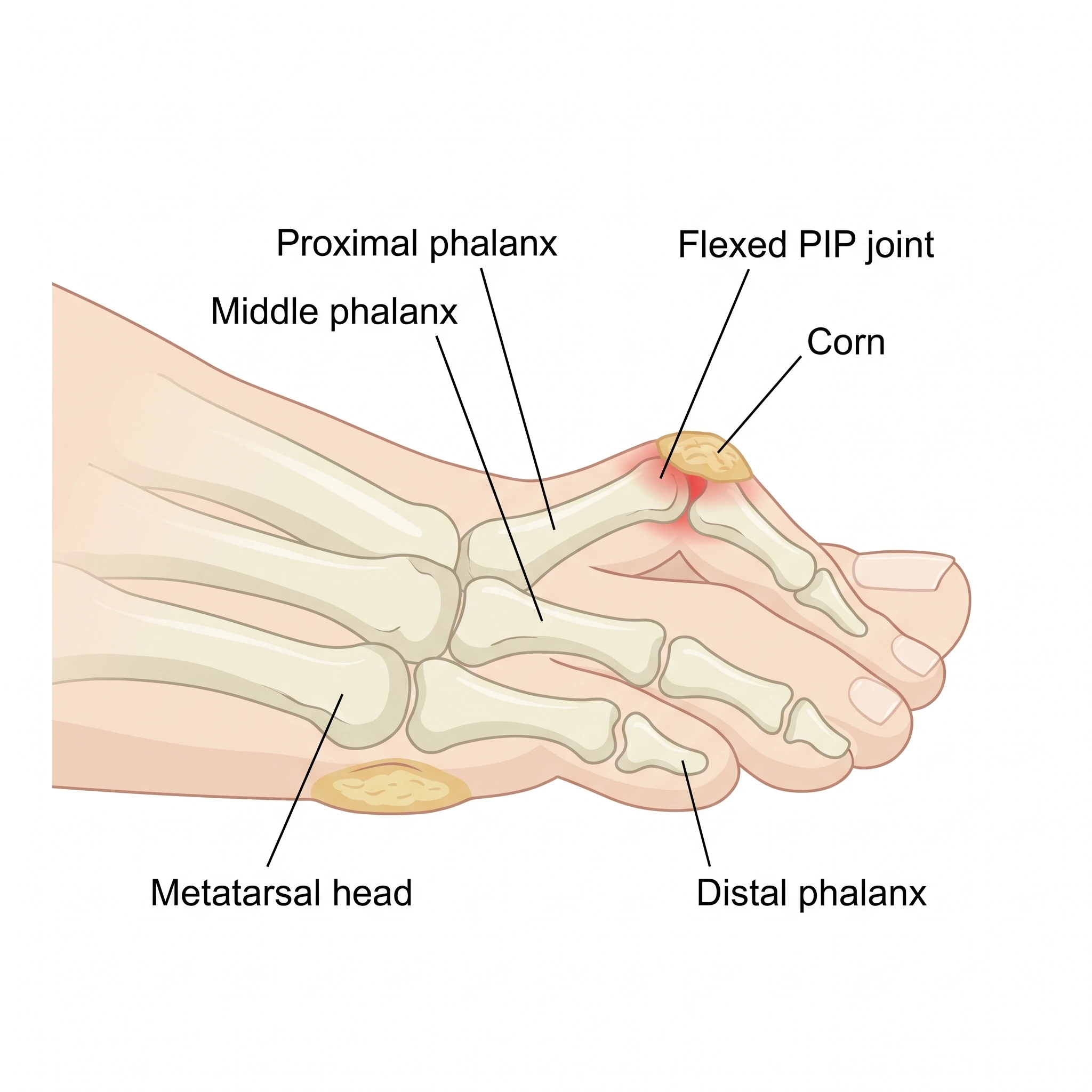
The corn on top sits over the raised knuckle of the middle joint. It is skin thickening in response to friction against the top of the shoe, hundreds of times a day. It tells you the toe is tall for the shoe, and it tends to disappear when the shoe gets deeper, which is the point most people miss when they treat the corn rather than the pressure. The American Podiatric Medical Association advises against cutting corns at home or using medicated corn pads, which contain acid that can burn healthy skin.
The callus under the ball of the foot is a different signal entirely. When the toe pulls up at its base, it drives the long bone behind it, the metatarsal, downward into the ground. Clinicians call this retrograde force. That metatarsal head now carries more than its share of body weight, and the skin under it thickens to protect itself.
That second callus matters clinically more than the first. It marks the spot the foot is overloading, it explains ball-of-foot pain that patients often report as a separate complaint, and it predicts what surgery has to address. Straightening the toe without unloading that metatarsal can leave the callus and the pain behind.
How is my shoe making this worse than it needs to be?
Three shoe measurements matter, and most people only check one.
Length is the one everyone checks, and it is checked wrong. The rule is a thumb's width beyond the longest toe, and the longest toe is not always the big toe. Sizing to the big toe on a foot with a long second toe leaves the second toe jammed every time. Feet also swell through the day, so a shoe fitted first thing in the morning can be a size too small by evening.
Width is the second, and it is what most people mean when they say a shoe pinches. Depth is the third, and it is the one that determines whether a bent knuckle rubs. Two shoes of the same length and width can have completely different vertical room over the toes. A shoe with a soft, stretchy upper is more forgiving over a raised knuckle than one with a stiff toe cap.
Heel height ties them together. A raised heel slides the whole foot forward, so a shoe that fits standing still becomes short with every step, and it also shifts weight onto the ball of the foot, which worsens the callus that is already there.
None of this reverses a hammertoe. It removes the daily force that is making it hurt and that keeps nudging it further along. For a flexible toe, that alone controls symptoms for years in many people.
What actually happens in hammertoe surgery?
The operation is chosen from the exam, which is why the flexible or rigid question matters so much.
For a flexible toe, the surgeon works on soft tissue. The tight tendon on top of the toe is lengthened or released, the tissue at the base of the toe is released so the toe can sit down, and the long flexor tendon underneath is sometimes detached and rerouted to the top of the toe, so the muscle that was curling the toe now holds it flat. No bone is removed.
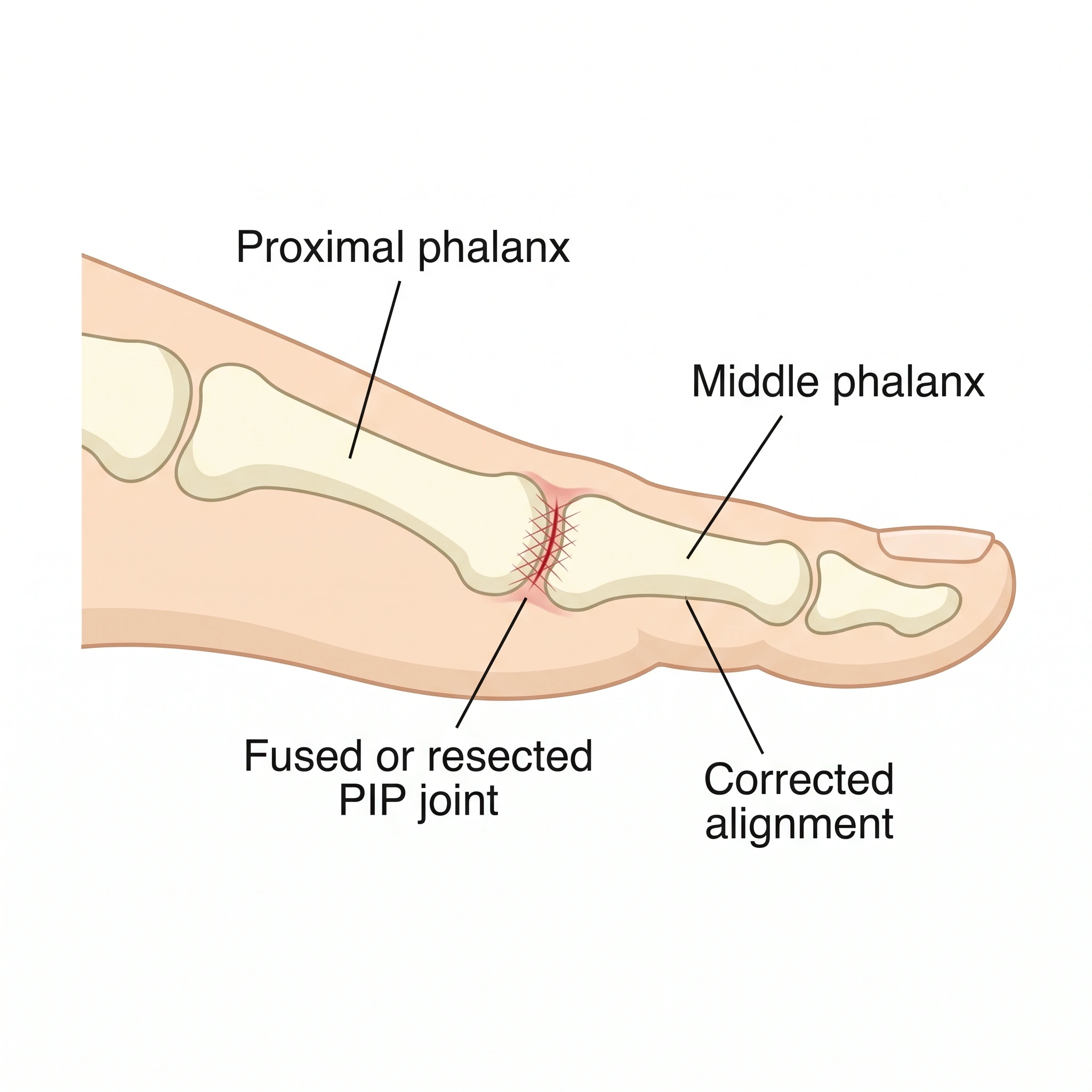
For a rigid toe, the joint itself has to be dealt with. In a joint resection, a small piece of bone is removed from the end of the first bone of the toe, which shortens the toe slightly and takes away the block. In a fusion, the two bone ends are prepared and held together so they heal as one straight segment. A fused toe does not bend at that joint again, which is the trade being made in exchange for a straight, comfortable toe.
Something has to hold the toe while it heals. That is often a thin wire that exits through the tip of the toe and is removed in the office a few weeks later, or an implant that stays inside the bone.
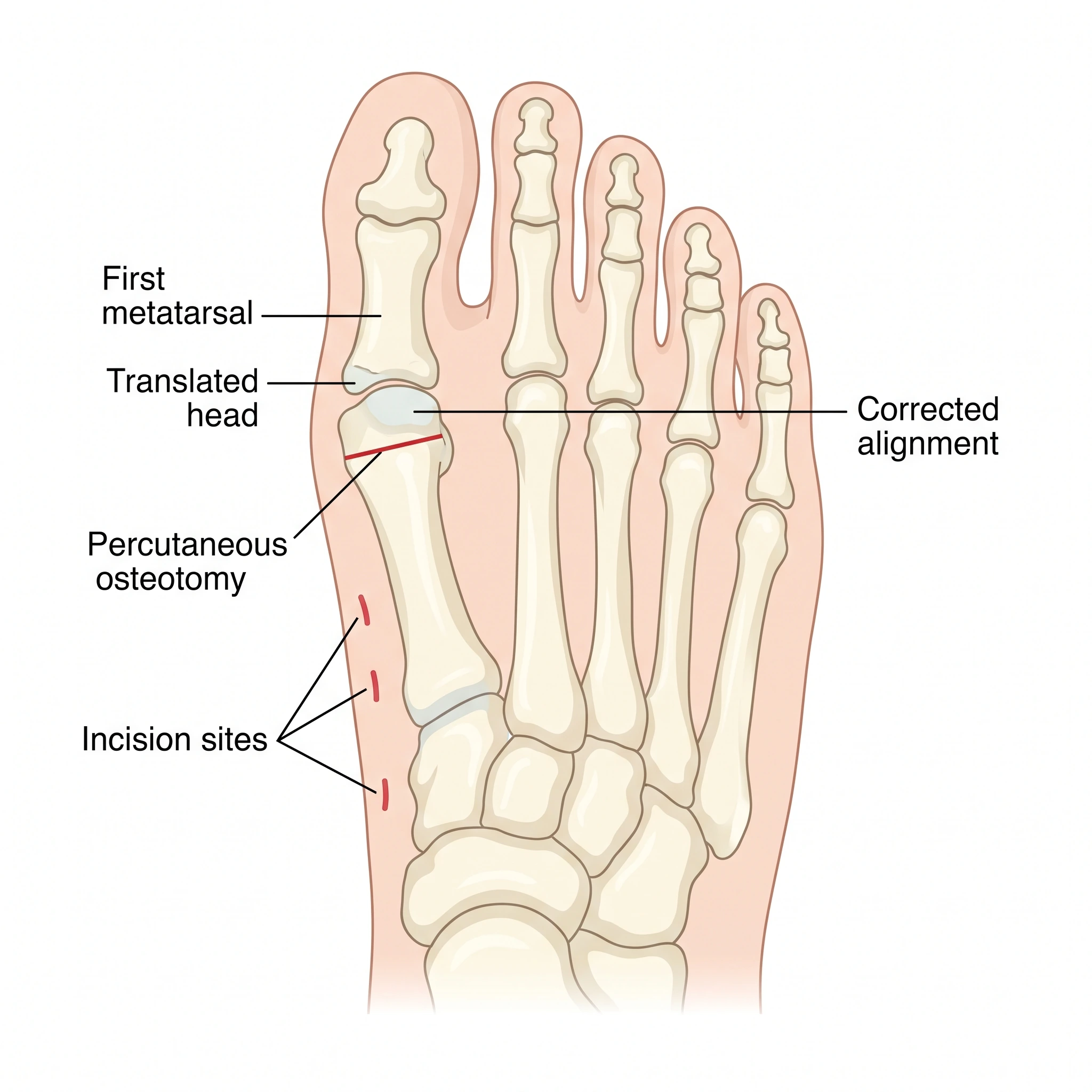
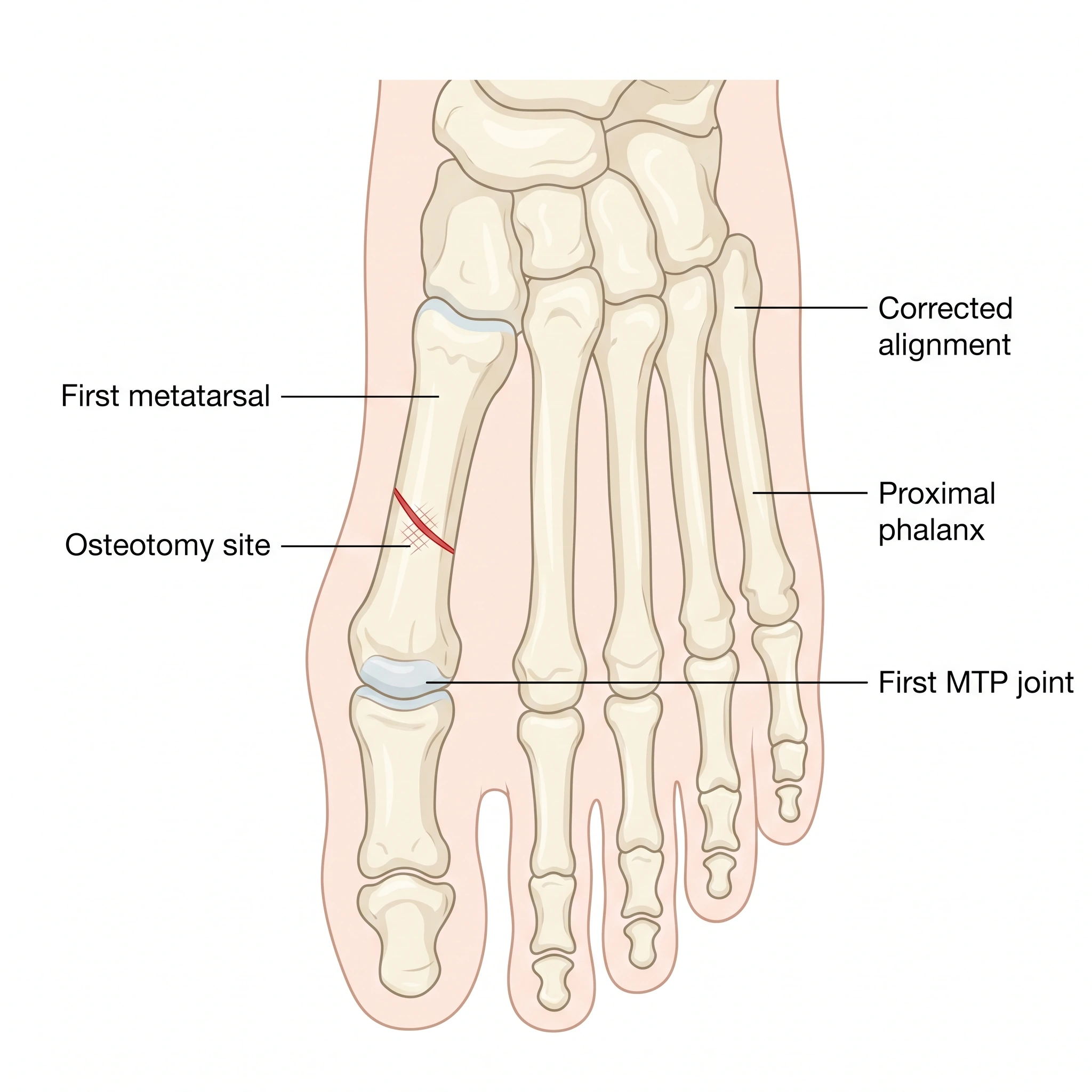
When the toe is also dislocated at its base, or when the metatarsal behind it is overloaded, the surgeon may shorten or elevate that metatarsal so the toe can sit down and the callus underneath is relieved.
What do the weeks after surgery actually feel like?
Most people are surprised by two things: how quickly they walk, and how long the swelling lasts.
Walking usually starts right away in a stiff, flat surgical shoe that keeps the forefoot from bending. That shoe is doing real work and is not optional. Bending through the toes early is what loosens a fixation and lets a corrected toe drift back.
If a wire was used, it stays in for a few weeks, and it looks more alarming than it feels. It is removed in the office without anesthetic in most cases, and people commonly describe it as a brief odd sensation rather than pain.
Swelling in a toe is stubborn because the foot is the furthest point from the heart and every step pumps fluid into it. Toe and forefoot swelling that comes and goes for several months after forefoot surgery is normal and does not mean anything has gone wrong. Elevating the foot above heart level for parts of the day is the most effective thing you can do about it.
Expect the toe itself to be stiff, and expect it to stay somewhat stiff, especially after a fusion. Numbness along one side of the toe is common early and usually settles. Return to a regular shoe is commonly reported over several weeks, according to general guidance from the American College of Foot and Ankle Surgeons, and return to running or a tight dress shoe takes longer. These are ranges, not promises.
Will fixing one toe cause problems in the others?
It is a fair question, and the answer is that it can, which is why the whole forefoot is assessed rather than the toe that hurts.
Toes share load. If the second metatarsal is shortened to let a second toe sit down, the third now carries relatively more, and a new callus can appear under it. Surgeons call this a transfer lesion. It is anticipated rather than discovered, which is why the plan often includes more than the obviously painful toe, and why the metatarsals are treated as a set with a shape rather than one at a time.
A bunion that is left uncorrected keeps pushing the second toe sideways, so a straightened second toe next to an untreated bunion has ongoing pressure against it. Whether the bunion is corrected at the same sitting is a real decision with real trade-offs in recovery length, and it is worth asking about directly.
None of this argues against surgery. It argues for a conversation about the whole forefoot before the first incision, so the plan is aimed at how you walk rather than at one knuckle.
What can I do to slow it down if I do not want surgery?
Quite a lot, and it is worth doing properly rather than half doing it.
Keep the toe moving. While a toe is still flexible, holding it straight with your fingers and holding for twenty or thirty seconds, several times a day, keeps the tissues from shortening. It does not reverse the bend and it does not need to. It preserves options.
Work the small muscles that lost the tug of war. Picking up a towel with the toes, spreading the toes apart against resistance, and pressing the pads of the toes into the floor without curling them all target the muscles that are supposed to hold the base of the toe down.
Get the pressure off. A crest pad, a small foam bar that sits in the hollow under the toes, holds them slightly straighter and is more useful for many people than a sleeve over the corn. A metatarsal pad placed behind the painful metatarsal head, not under it, unloads the callus.
Have the calluses trimmed rather than attacking them at home, and have the feet checked regularly if you have diabetes, neuropathy, or reduced circulation, where a corn over a bent toe is a pressure point that can break down. Managing a hammertoe well is ordinary maintenance, and for a great many people it is all that is ever needed.
What are the treatment options?
- 01Shoes with a deep, wide, and long toe box so the bent knuckle has room above itShoes with a deep, wide, and long toe box so the bent knuckle has room above it
- 02A gel toe sleeve or a crest pad that sits under the toes and holds them straighterA gel toe sleeve or a crest pad that sits under the toes and holds them straighter
- 03Daily passive stretching of the toe while it is still flexible, and toe strengthening forDaily passive stretching of the toe while it is still flexible, and toe strengthening for the small muscles of the foot
- 04A metatarsal pad or custom orthotics to unload the metatarsal head under the ball of the fA metatarsal pad or custom orthotics to unload the metatarsal head under the ball of the foot
- 05Professional trimming of corns and calluses, repeated as neededProfessional trimming of corns and calluses, repeated as needed
- 06A short course of anti-inflammatory medicine for an inflamed joint, when safe for youA short course of anti-inflammatory medicine for an inflamed joint, when safe for you
- 07Soft tissue release or tendon transfer for a flexible toe that stays painfulSoft tissue release or tendon transfer for a flexible toe that stays painful
- 08Hammertoe surgery with joint resection or fusion for a rigid, painful toe, considered whenHammertoe surgery with joint resection or fusion for a rigid, painful toe, considered when the steps above no longer keep it comfortable
What do patients ask most?
Do the toe straighteners and splints sold online work?+
Should I have both feet done at the same time?+
Can a hammertoe come back after surgery?+
Why does the joint at the base of my toe hurt more than the bent knuckle?+
Does having diabetes change how a hammertoe is handled?+
Trained at Adventist Health White Memorial, Los Angeles (three-year foot and ankle surgical residency, Chief Resident). Sees patients in Fort Lauderdale.
About Dr. Tine →