Why an ulcer is not an ordinary sore and why time matters, why offloading is the part people skip and why a cast that cannot be removed works better than a boot, the three things that decide whether it heals, why cleaning out is repeated, and which signs mean calling today.
Stephanie Tine diagnoses and treats diabetic foot ulcer / wound care in Fort Lauderdale, from the first visit through recovery.
Why is this different from an ordinary sore?
An ordinary sore closes itself.
Skin cells crawl in from the edges, the gap fills, and within a week or two there is nothing to see. That process needs three things: blood arriving, tissue that is clean, and enough rest from pressure for the new tissue to hold.
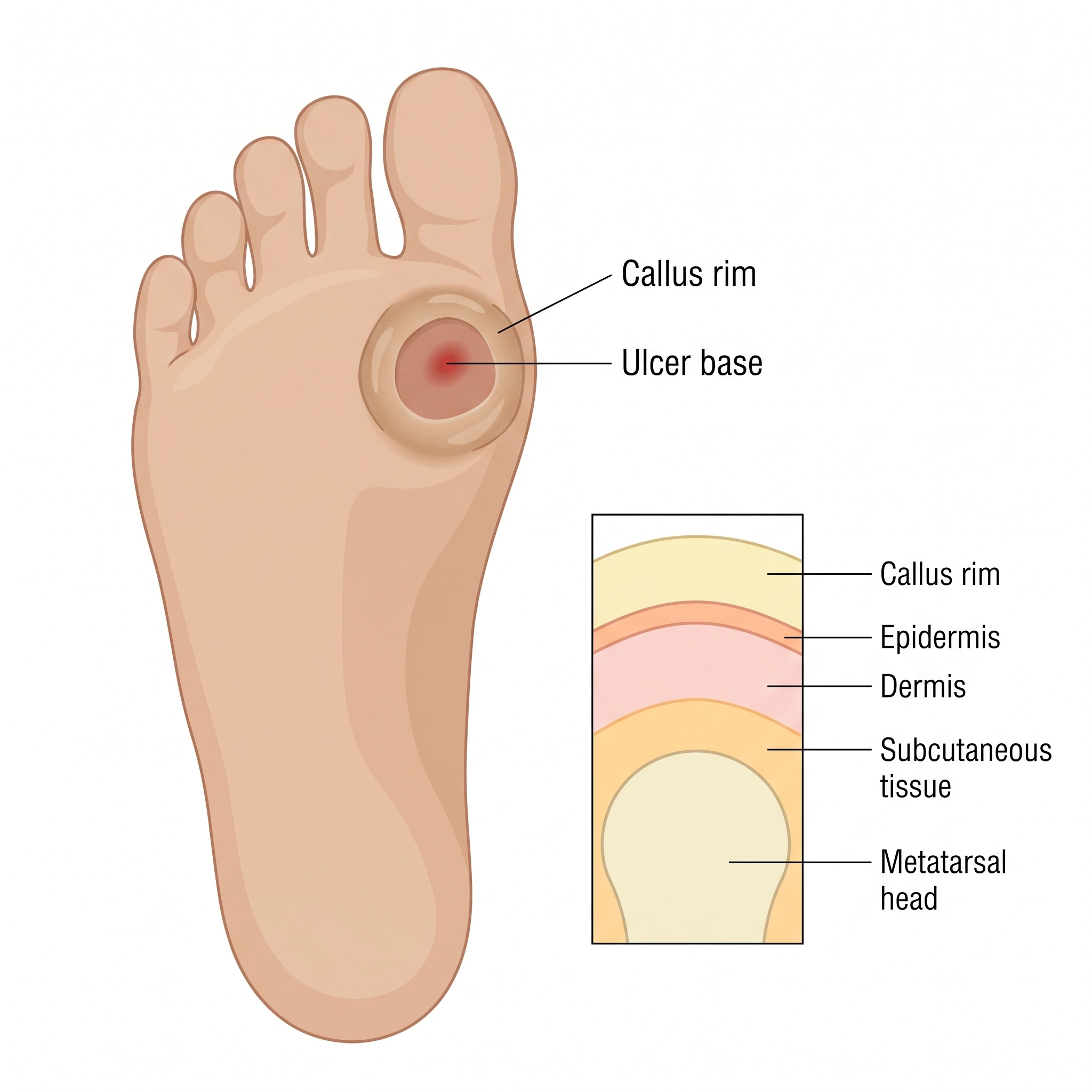
A diabetic foot ulcer is a wound in which at least one of those three is missing, usually more than one. So it does not close, and after a few weeks it changes character. The edge thickens and rolls under. The cells at the rim, which should be migrating across the gap, stop moving. A film of bacteria settles on the surface that ordinary washing does not remove. At that point the wound is not a sore that is taking a long time. It is a wound sitting in a different state, and getting it out of that state is what treatment is for.
There is a second difference, and it is the one that costs people the most. This wound usually does not hurt. Patients describe it as a spot, a hole, a place that will not scab. Nothing about how it feels matches how serious it is. A wound that hurts gets attention automatically. A wound that does not hurt has to be given attention on purpose.
What you can see is also not the whole wound. Ulcers undercut the skin at the edges and tunnel under a rim of callus, so the opening is often the smallest part of it.
Why does time matter so much with this?
Because two clocks are running.
The first is infection. An open wound on the foot is a doorway, and skin bacteria walk through it. Underneath the skin of the sole there is very little padding between the surface and the tendons, joints, and bones. Tendon sheaths run the length of the foot and can carry an infection from the ball of the foot toward the ankle. When infection reaches bone, treatment stops being dressings and becomes weeks of antibiotics, surgery, or both. The distance from a surface wound to a bone infection is measured in millimeters and, sometimes, in days.
The second clock is the wound itself. The longer it stays open, the more set that stalled edge becomes, and the more work it takes to restart. A wound seen in its first week is often a straightforward problem. The same wound seen two months later is usually several problems stacked together.
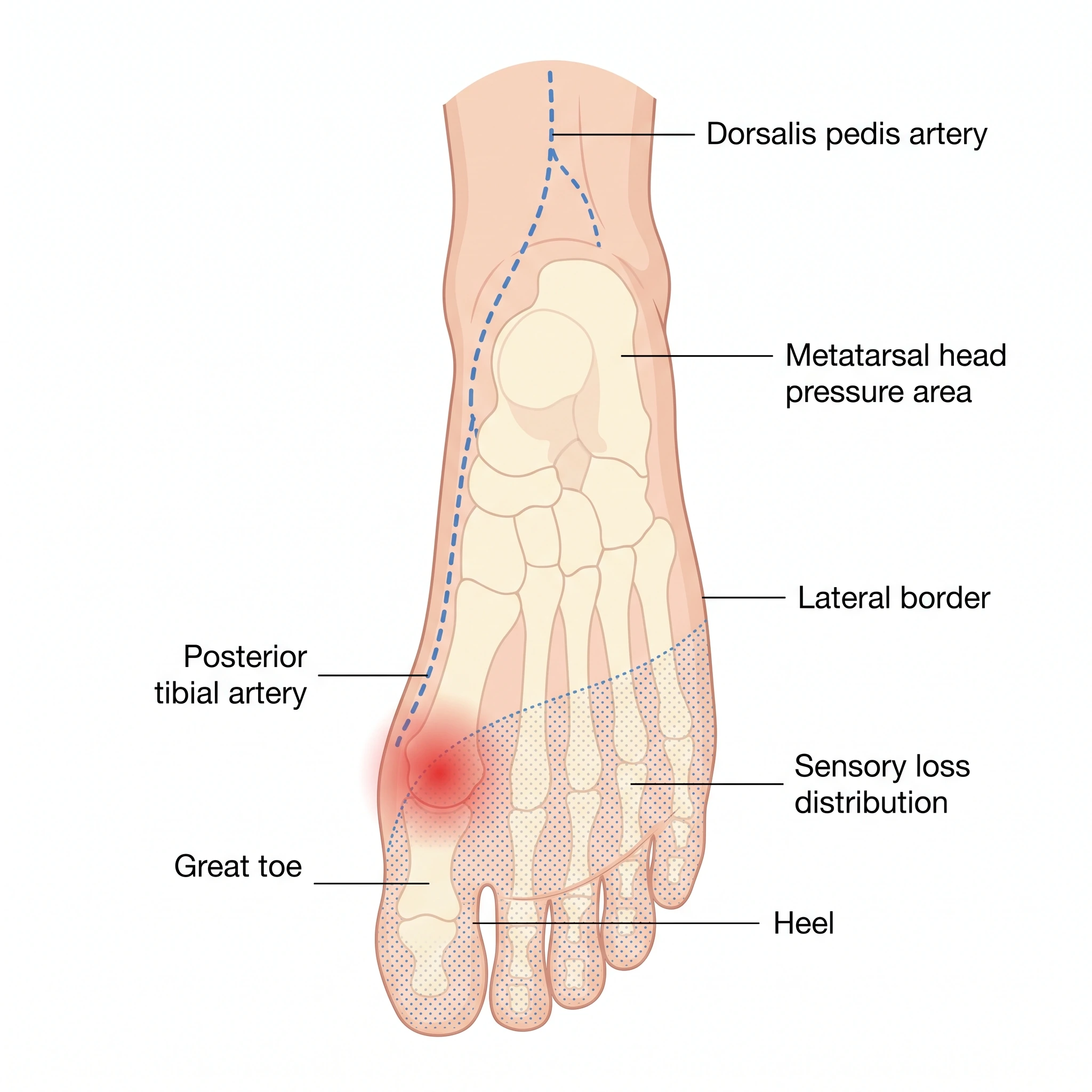
There is a third reason, less obvious. A wound that will not heal is often the first hard evidence that circulation is reduced. Many people with narrowed leg arteries have no leg cramping at all, because neuropathy hides it. The ulcer is what brings it to light, and finding it early leaves more options open.
The American College of Foot and Ankle Surgeons describes early evaluation of a diabetic foot wound as the point at which the course of that wound is largely decided. Being seen this week rather than next month is the single largest thing within your control.
Why is offloading the part people skip?
Offloading means taking the weight off the wound.
It is the treatment with the most direct effect on healing and the one most often done halfway.
Picture what the wound is trying to do. New tissue grows across the gap as a thin, fragile bridge, a fraction of a millimeter at a time. Standing on that bridge crushes it. Walking on it shears it sideways, which is worse. A day of ordinary walking can undo several days of growth, and it happens without any sensation to warn you.
The reasons people take the device off are all understandable. The boot is hot and heavy. It makes one leg longer, so the hip and the back start aching. It is awkward in the car and impossible in the shower. And above all, the foot does not hurt, so nothing about the body's own signals says this is necessary.
Two practical fixes help. A balancing shoe or an add on sole for the other foot evens out the leg lengths and takes care of the hip and back ache. And the device stays on for every step inside the house, which is where most unprotected steps happen. The trip to the bathroom at two in the morning is not an exception; over a week it is dozens of steps directly on the wound.
If the device is not workable for you, say so at the visit. There is more than one way to offload a foot, and a device that gets worn beats a better device that does not.
Why does a cast that cannot be taken off work better than a boot?
A total contact cast is a snug cast molded closely to the whole shape of the foot and lower leg.
It works in two ways.
The first is physics. Because it contacts the entire sole and the leg, load that was landing on one small area is spread across a much larger one, and the ankle is held still so the hard push off at the end of each step is reduced. The peak pressure at the ulcer drops sharply.
The second is simpler and probably matters more. It does not come off. Every removable device in the world has the same weakness, which is the human being wearing it. A cast removes that variable entirely.
The honest trade offs go with it. The wound cannot be looked at daily, so the cast is changed in the office on a regular schedule, often weekly, which is also when the wound is checked and debrided. It is not used when there is significant infection or when circulation is very poor, because those wounds need to be seen more often. Bathing takes a cover and some planning, and driving may not be possible with a cast on the right foot. Skin at the cast edges is checked at every change.
When a cast is not suitable, a removable boot that is wrapped so it cannot easily be taken off is a middle option. The American College of Foot and Ankle Surgeons describes total contact casting as a standard approach for offloading wounds on the bottom of the foot.
What three things decide whether this wound heals?
Blood supply, infection, and pressure.
Almost everything in the treatment plan is aimed at one of the three, and a wound that is not healing usually has one of them unaddressed.
Blood supply is first, because nothing else works without it. Healing tissue needs oxygen, and antibiotics only reach a wound the blood reaches. Circulation is checked by feeling pulses and, when they are hard to find, by comparing blood pressure at the ankle or toe with the arm. If flow is too low, dressings and offloading alone will not close the wound, and restoring flow comes first. Peripheral arterial disease covers this in detail.
Infection is second. Every open wound has bacteria on it; that alone is not infection. Infection means the bacteria are invading tissue, and it shows as spreading redness, warmth, swelling, increased or thicker drainage, odor, or a wound that suddenly worsens. It is treated with antibiotics guided by a culture, and sometimes with surgery to drain or remove infected tissue and bone.
Pressure is third and it is the one that caused the wound in the first place. It is also the one that keeps it open.
Blood sugar control and nutrition sit underneath all three, because both affect how well tissue repairs and how well the body fights infection. A page cannot tell you which of the three is holding your wound back. The exam and the circulation tests can, and that answer is what shapes the plan.
Why does the wound have to be cleaned out over and over?
Because a stalled wound rebuilds the things that stalled it.
Debridement is the removal of dead tissue, the soft yellow layer called slough, and the ring of hard callus around the edge. Each of those actively prevents closure. Dead tissue is a place for bacteria to live and a physical barrier the new cells cannot cross. The callus rim acts like a tight collar around the wound, raising pressure at the edge and rolling it under so the skin cells at the rim face the wrong way. The film of bacteria on the surface is broken up by physically removing it, which is something a dressing cannot do.
There is a more useful way to think about it. Debridement converts a chronic wound into a fresh one. The edges bleed a little, the surface is clean, and the healing machinery gets a signal to start again. That is why it is repeated rather than done once, usually at every visit, because within a week or two the edge has begun to build back up.
One thing surprises people. After debridement, the wound often looks bigger. That is not the wound getting worse. It is the true size of the wound now that the dead tissue and undermined edges have been taken away, and measuring from that honest starting point is how progress is tracked. The mechanics of each visit are described on diabetic wound care.
Which signs mean call today rather than at the next visit?
These are the ones that should not wait.
Redness spreading out from the wound onto the surrounding skin, or new warmth or swelling anywhere in the foot. Drainage that has increased, thickened, or turned gray, green, or cloudy. A new smell. A wound that is suddenly deeper, wider, or dark at the base. Any black tissue. Fever or chills.
Two others are easy to miss. The first is blood sugar that has become unexpectedly hard to control when nothing about your diet or medicine has changed, which can be the earliest sign of infection anywhere in the body. The second is new pain in a foot that normally does not hurt. Pain returning to a numb foot is not reassurance that feeling is coming back. It usually means something has grown serious enough to break through, and it is treated as urgent.
A toe or the foot turning pale, blue, or black, or feeling cold, needs care the same day. Red streaks running up the leg, feeling generally unwell, or a wound that changes quickly over a few hours is an emergency room visit rather than a phone call.
Calling early is never wasted. Being told the wound looks fine is a good outcome for a phone call, and the office would far rather look at ten wounds that turn out to be stable than see one late.
What happens after the wound closes?
Closing the wound is the halfway point, and it is worth knowing that at the start rather than at the end.
New skin over a healed ulcer is thin. It has no sweat glands, little elastic tissue, and it sits on scar rather than on the fat pad that used to cushion it. It has meaningfully less strength than the skin around it, and it takes less to break it open again. Meanwhile, the pressure point that produced the wound in the first place has not gone anywhere.
So the plan changes rather than stops. Return to ordinary shoes is gradual and supervised, an hour or two at a time with the skin checked afterward. Most people move into protective footwear with a custom accommodative insole, which is built to spread load away from that spot rather than to correct alignment; custom orthotics explains the difference. Follow up visits continue at intervals rather than ending, and the daily check described on diabetic foot care becomes a permanent habit.
Some clinicians describe a healed diabetic foot as being in remission rather than cured. That framing is useful, because it sets the right expectation without being frightening. The skin is closed and life goes back to normal. The foot stays a foot that needs watching.
What are the treatment options?
- 01Taking pressure off the wound at every step, with a surgical shoe, a removable boot, or aTaking pressure off the wound at every step, with a surgical shoe, a removable boot, or a total contact cast chosen for the wound's location and for how reliably the device gets worn
- 02Cleaning and debridement of the wound and its callus rim in the office, repeated at each vCleaning and debridement of the wound and its callus rim in the office, repeated at each visit
- 03A dressing matched to how wet the wound is, changed at home on a set scheduleA dressing matched to how wet the wound is, changed at home on a set schedule
- 04Blood sugar management with your diabetes care team, which affects both healing and infectBlood sugar management with your diabetes care team, which affects both healing and infection
- 05A wound culture and antibiotics when infection is presentA wound culture and antibiotics when infection is present
- 06Circulation testing, and referral to a vascular specialist when blood flow is lowCirculation testing, and referral to a vascular specialist when blood flow is low
- 07Additional treatments such as skin substitutes or negative pressure therapy for a wound thAdditional treatments such as skin substitutes or negative pressure therapy for a wound that has stalled despite all of the above
- 08Surgery to drain infection, remove infected bone, or correct the deformity that keeps prodSurgery to drain infection, remove infected bone, or correct the deformity that keeps producing the wound
What do patients ask most?
Can I keep working while a foot ulcer heals?+
My wound has scabbed over. Does that mean it is healing?+
Will I need to be in the hospital?+
Why has my blood sugar been harder to control since the wound started?+
What if I cannot manage the dressing changes myself?+
Trained at Adventist Health White Memorial, Los Angeles (three-year foot and ankle surgical residency, Chief Resident). Sees patients in Fort Lauderdale.
About Dr. Tine →