Adult acquired flatfoot is an arch that has gradually collapsed, most often because the posterior tibial tendon that supports it has weakened, causing pain along the inside of the ankle and a foot that tilts outward. Dr. Tine treats flatfoot in Fort Lauderdale, beginning with bracing, orthotics, and strengthening.
Stephanie Tine diagnoses and treats flatfoot (adult acquired / pttd) in Fort Lauderdale, from the first visit through recovery.
What is adult acquired flatfoot?
Adult acquired flatfoot is an arch that has fallen over time in a foot that used to have one.
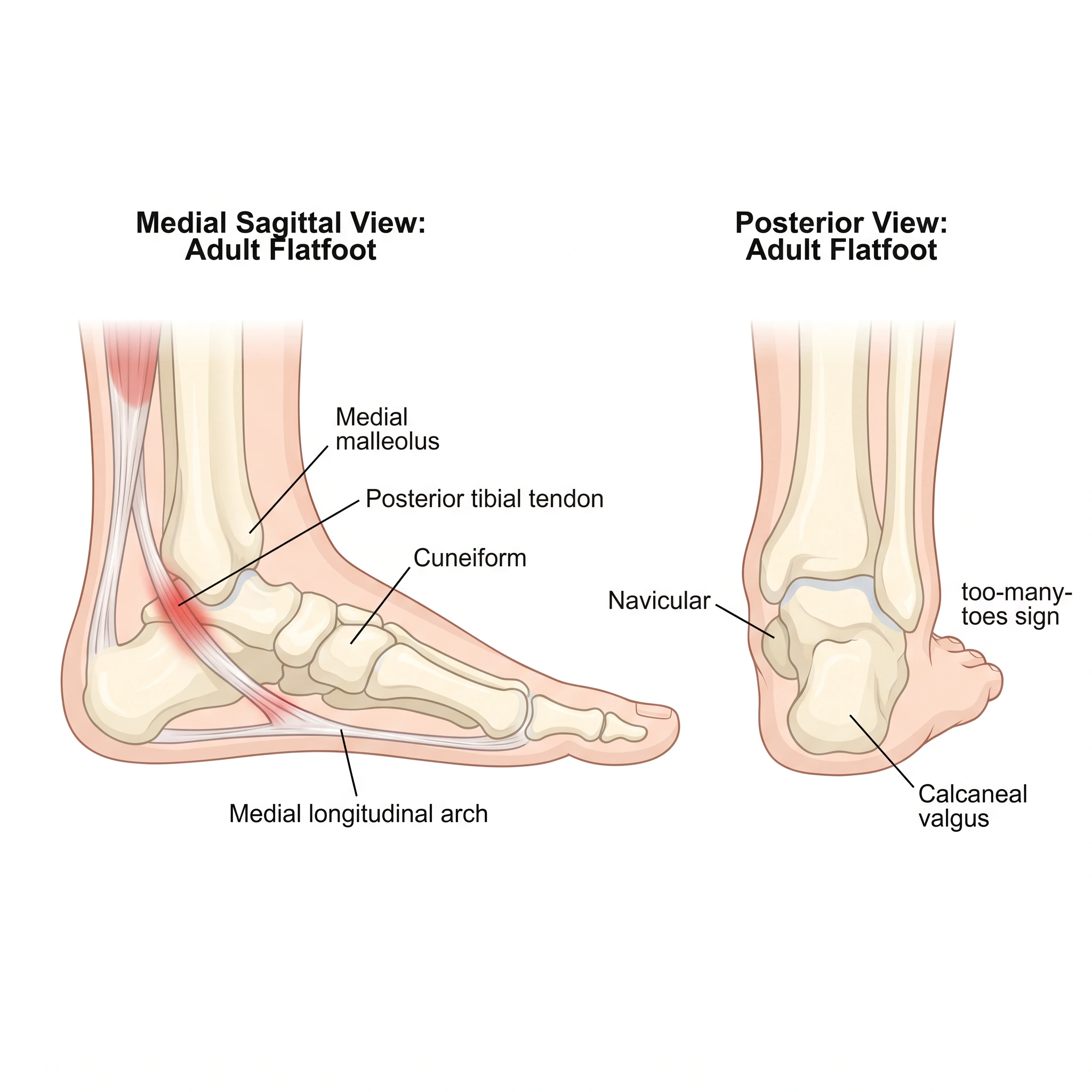
The usual cause is posterior tibial tendon dysfunction, PTTD, a weakening of the tendon that runs behind the inner ankle bone and holds up the arch. As the tendon stretches and frays, the arch drops, the heel tilts outward, and the front of the foot drifts out to the side.
Early on, people notice pain and swelling along the inside of the ankle, especially after standing or walking, and trouble rising onto the toes on one leg. Later, the pain can shift to the outside of the ankle as the bones there begin to press together, and the foot becomes stiff.
Flatfoot from birth is different. It is usually flexible, often painless, and rarely needs treatment. The adult acquired kind progresses if it is ignored, which is why early bracing matters.
How is adult flatfoot diagnosed?
Adult flatfoot is diagnosed by exam and X-ray.
Dr. Tine looks at the arch and the heel from behind while you stand, checks whether the arch reappears when you rise onto your toes, tests the strength of the posterior tibial tendon, and asks you to rise onto the toes of one leg, which is hard or impossible when the tendon has failed. Standing X-rays show how far the bones have shifted and whether arthritis has started. MRI shows the tendon itself when the stage is unclear.
What can you expect from flatfoot treatment?
Early-stage flatfoot is often controlled for years with bracing, orthotics, and strengthening.
When the tendon has failed and the foot is still flexible, reconstruction transfers a healthy tendon to replace it and realigns the heel and arch with bone cuts, which is a long recovery: no weight in a cast for weeks, then a boot, then shoes with orthotics. Return to comfortable walking is commonly reported over several months, according to general guidance from the American Academy of Orthopaedic Surgeons. A stiff, arthritic flatfoot is treated with fusion instead. These are ranges, not promises.
What are the treatment options?
- 01Rest from long standing and impact, with a short period in a walking boot for a painful flRest from long standing and impact, with a short period in a walking boot for a painful flare
- 02Ice and anti-inflammatory medicine for a short course, when safe for youIce and anti-inflammatory medicine for a short course, when safe for you
- 03Supportive shoes with a firm heel counter and a stiff soleSupportive shoes with a firm heel counter and a stiff sole
- 04Custom orthotics or an ankle brace that holds the heel upright and supports the archCustom orthotics or an ankle brace that holds the heel upright and supports the arch
- 05Physical therapy to strengthen the posterior tibial tendon and stretch a tight calfPhysical therapy to strengthen the posterior tibial tendon and stretch a tight calf
- 06A custom ankle-foot brace for a foot that has become stiffA custom ankle-foot brace for a foot that has become stiff
- 07Flatfoot reconstruction, rebuilding the tendon and realigning the bones, considered when bFlatfoot reconstruction, rebuilding the tendon and realigning the bones, considered when bracing no longer controls pain or the foot keeps collapsing
What do patients ask most?
Is flatfoot the same thing as fallen arches?+
Can my arch be rebuilt without surgery?+
Why does the outside of my ankle hurt now?+
How long is recovery after flatfoot reconstruction?+
Trained at Adventist Health White Memorial, Los Angeles (three-year foot and ankle surgical residency, Chief Resident). Sees patients in Fort Lauderdale.
About Dr. Tine →