Why nail fungus is so much harder to treat than a skin infection, why it takes most of a year to see a normal nail, how to know it is actually fungus, the real trade offs between topical, oral, and laser, why bloodwork comes before an oral drug, and what keeps it from returning.
Stephanie Tine diagnoses and treats toenail fungus in Fort Lauderdale, from the first visit through recovery.
Why is nail fungus so much harder to treat than a skin infection?
Because of where it lives.
A nail plate is a sheet of dead, tightly packed keratin with no blood supply of its own. Nothing your immune system carries in the bloodstream reaches it. Antibodies, white cells, and any medicine circulating in your blood arrive at the living tissue underneath and at the matrix behind, but not into the plate itself. The fungus is sitting in a place your body cannot patrol.
Topical medicine faces the mirror-image problem. To reach the infection it has to soak through that hard plate from the outside, and keratin is very good at not letting things through. This is why a cream that clears athlete's foot on the skin in two weeks does almost nothing to a nail, and why nail-specific lacquers and solutions are formulated to penetrate and still have to be applied every day for many months.
Thickness makes it worse in a straight line. As the infection progresses, the plate thickens and debris builds under it, so the medicine has further to travel through more material. A dense pocket of fungus can form under the nail, sometimes called a fungal ball, which topical treatment struggles to get into at all.
Then there is the reservoir. The same organisms live on the skin of the foot, in the lining of your shoes, and often on other nails, so even a perfectly treated nail sits in a shoe that can reinfect it. Treating the nail and ignoring the environment is the most common reason a good result does not hold.
Why does it take nine to twelve months to see a normal nail?
Because a nail cannot be repaired, only replaced.
Everything you see is produced at the matrix, the strip of living tissue tucked under the skin fold at the base of the nail. The matrix builds new plate and pushes it forward, and the plate is dead from the moment it appears. The discolored, thickened part of your nail cannot recover, no matter what happens to the fungus in it. It has to grow out to the end and be trimmed off.
That takes a long time on a toe. A fingernail replaces itself over roughly half a year. A big toenail is slower, commonly around a year from base to tip, and slower still in older adults and in feet with reduced circulation. These are ranges, not promises.
This changes how you should judge treatment, and it is the point most people miss. You do not look at the whole nail and ask whether it looks better. You look at the base, at the few millimeters that have emerged since treatment started, and you ask whether that new growth is clear and normal in thickness. Clear new nail at the base with an ugly old nail ahead of it is treatment working.
It also means a course of treatment finishing is not the same as the nail looking normal. Oral medicine is typically taken for weeks to months, and the nail keeps improving for many months after the last tablet, because the drug stays in the nail as it grows out.

How do I know it is actually fungus?
You often cannot know by looking, and neither can anyone else with certainty.
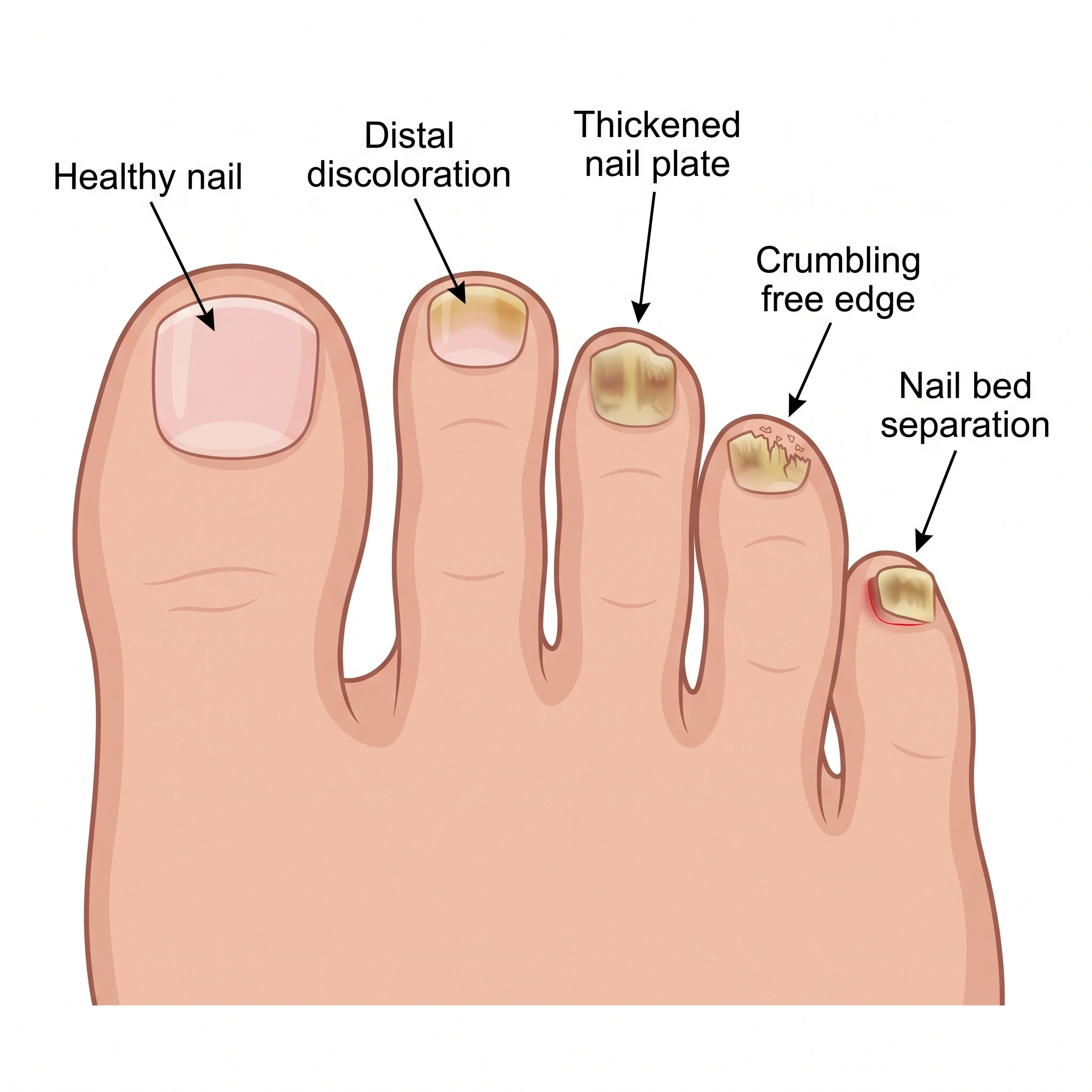
A thick, yellow, crumbling nail has several possible explanations, and this matters because the treatments are not interchangeable.
Repeated trauma is the most common impostor. A toe that hits the front of a shoe thousands of times, in runners, hikers, and anyone whose second toe is long, thickens and discolors in a way that looks identical to fungus. The nail is reacting to being hit, not infected.
Skin conditions account for many of the rest. Nail psoriasis produces pitting, oil-drop discoloration, and separation of the plate from the bed, and it can appear in someone with no obvious skin plaques. Lichen planus, eczema around the nail, and old injuries all change nail appearance.
A few look-alikes are important rather than merely confusing. Blood trapped under a nail from an unnoticed injury darkens and grows out. A dark streak running the length of the nail, a lesion that pigments the surrounding skin, or a nail that is bleeding and not healing needs to be examined rather than assumed benign, because melanoma can appear under a nail.
Confirmation is straightforward. A clipping of the nail and some of the debris under it is sent for laboratory examination, culture, or a molecular test. It costs a visit and a wait. It is worth it before committing to months of daily medicine or a course of tablets that requires bloodwork, and Dr. Tine will explain which test is being used and why.
What are the real trade-offs between topical, oral, and laser?
Topical treatment is the safest and the slowest.
There is no bloodwork, no interaction with your other medicines, and the main risk is local irritation. What you give up is effectiveness. Topicals work most reliably on mild infection at the tip of the nail, in thin nails, and when only one or two nails are involved. They are applied every single day for up to a year, and adherence over that stretch is the usual point of failure.
Oral treatment is the most effective and carries the most to discuss. It reaches the nail through the bloodstream and the matrix, so it treats from the inside out. It runs for weeks to months. It requires a careful review of everything else you take, because these medicines interact with a meaningful list of common drugs, and it usually requires bloodwork to check the liver before and sometimes during treatment. It is not appropriate for everyone, and pregnancy, liver disease, and certain heart conditions all change the conversation.
Laser sits in an awkward middle. It is done in the office, involves no medicine, needs no bloodwork, and usually takes several sessions. It is also usually paid for out of pocket, because insurers commonly treat it as cosmetic. The honest summary is that the evidence for lasting cure is weaker and less consistent than for oral medicine, and it is more fairly described as improving the look of the nail than as reliably eradicating the organism.
The American Podiatric Medical Association describes nail fungus as difficult to treat and prone to returning, and that is the honest summary of every route on this list. No option here carries a high certainty of permanent cure.
Why does bloodwork come before an oral antifungal?
Because these medicines are processed by the liver, and the point of the test is to know your starting position rather than to discover a problem later.
A baseline liver panel is standard before starting, and depending on the medicine, the dose, the length of the course, and your other health conditions, it may be repeated partway through. Your clinician will tell you which applies to you.
The medication review matters just as much and gets less attention. Oral antifungals interact with a long list of common drugs, including some cholesterol medicines, some blood thinners, certain heart rhythm medicines, and several others. The interaction is not always in the direction people assume; sometimes the antifungal raises the level of the other drug. Bring an actual list, including anything from a supermarket shelf and any supplements.
There is also a short list of symptoms to report during treatment rather than wait out: yellowing of the skin or eyes, dark urine, pale stools, persistent nausea, unusual tiredness, or a rash. These are uncommon, and knowing what to watch for is part of taking the medicine sensibly.
None of this makes oral treatment a bad choice. It makes it a considered one, and it is the reason confirming the diagnosis first is worth the extra visit.
Does a thick nail need to be thinned or removed?
Thinning the nail, called debridement, is a useful treatment in its own right, and it is underrated because it sounds like grooming.
Reducing the thickness does three things. It relieves the pressure pain a thick nail causes inside a shoe, which for many people is the only symptom that actually matters. It removes a large amount of infected material in one go, lowering the fungal load. And it thins the barrier that topical medicine has to cross, which is why debridement paired with a topical works better than the topical alone.
It is not a one-off. Because the nail keeps growing from an infected matrix and bed, thinning is typically repeated every couple of months for as long as it is helping. For many people, particularly older adults who would rather not take tablets, ongoing debridement is the whole treatment plan and a reasonable one.
Removing a nail entirely is a bigger step, used when the plate is badly deformed, painful, repeatedly infected, or too thick for anything to penetrate. It is done surgically under local anesthetic or chemically with a urea preparation that softens the plate over days, and the exposed nail bed can then be treated directly. A new nail growing over a damaged bed is often ridged, and a nail removed once can grow back infected if the environment has not changed.
When does a fungal nail actually matter medically?
For most people this is a cosmetic and comfort problem, and choosing not to treat it is a legitimate decision.
There are situations where that calculation changes.
The clearest is diabetes. A thickened nail is a rigid object pressing on the toe inside a shoe, and in a foot with reduced sensation from peripheral neuropathy that pressure is not felt. It can wear a sore into the nail bed or the tip of the toe. The cracks that fungal infection creates in the surrounding skin also give bacteria a route in, and cellulitis of the leg often starts at a foot with fungal skin and nail disease.
Reduced circulation, from peripheral arterial disease or otherwise, matters for the same reason and adds another: everything heals more slowly, so a small problem takes longer to become a large one. A weakened immune system, whether from medication or illness, does the same.
Pain is its own reason. A nail thick enough to hurt with every step, or one that has lifted and catches, deserves treatment regardless of appearance.
And there is the spread argument. An untreated nail keeps reinfecting the skin of the foot and the other nails, and it is a source for other people in the household. Treating it is not only about the nail you are looking at.
What keeps it from coming back once it clears?
The shoes. If you take one thing from this page beyond patience, take that.
A shoe that has been worn by an infected foot holds fungal spores in its lining and insole, and it is warm and damp for hours a day. Put a treated foot back into an untreated shoe and you have handed the organism a second chance. Rotate at least two pairs so each gets a full day to dry, pull removable insoles out at night, and use an antifungal spray or powder inside the shoes rather than only on the feet. Shoes that cannot dry, such as work boots worn daily, are the hardest case and often need a second pair.
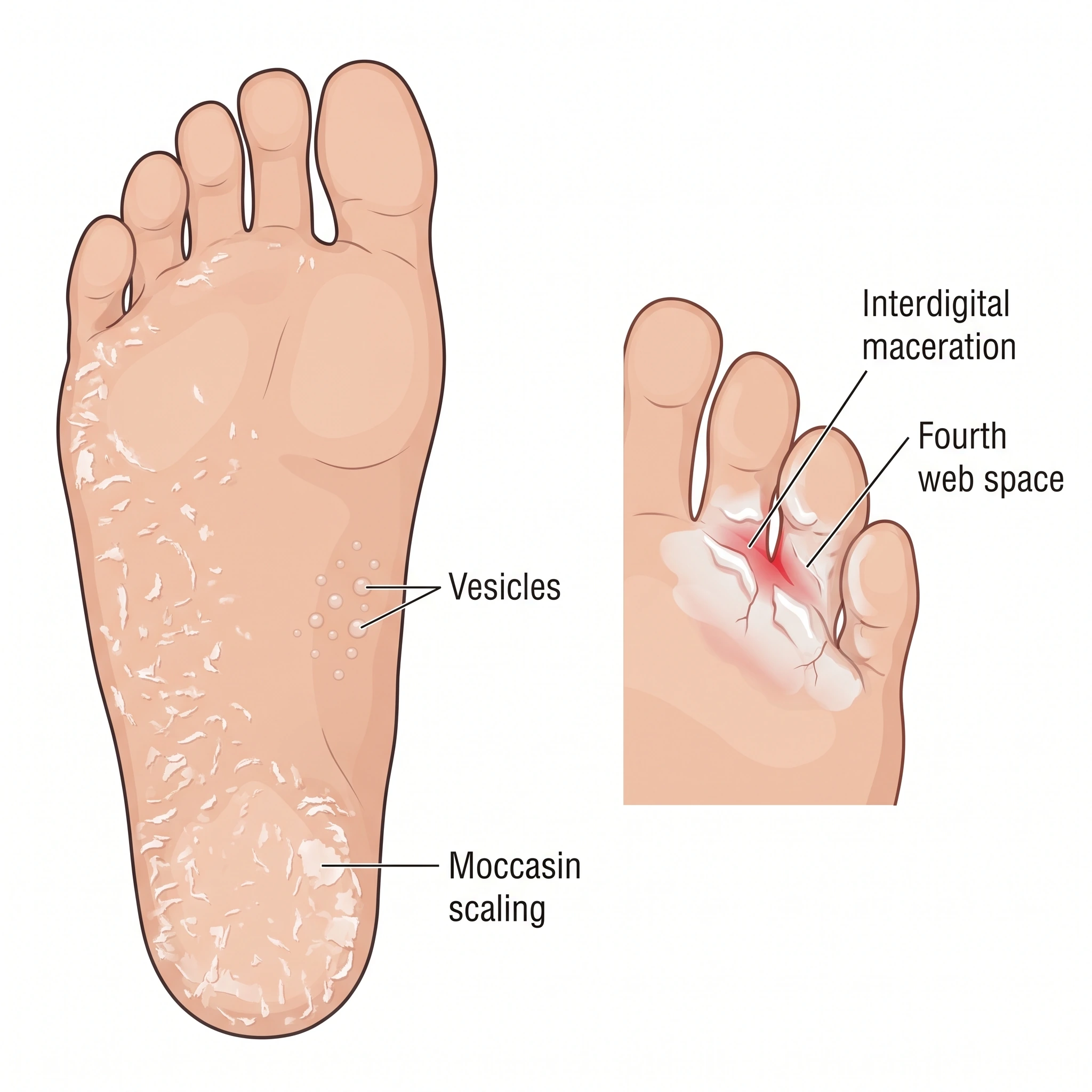
Treat the skin, always. Nail infection usually begins as athlete's foot and returns the same way, so the sole and the spaces between the toes are treated alongside the nails and kept treated afterward.
Keep the feet dry. Change socks when they are damp rather than once a day, choose moisture-wicking material over cotton for anything active, and dry carefully between the toes.
Protect the shared floors. Sandals in locker rooms, gym showers, pool decks, and hotel bathrooms. At home, a household member with untreated athlete's foot will keep reseeding the bathroom floor.
And keep your tools yours. Use a separate clipper for an infected nail, clean it after each use, and ask a nail salon how instruments are sterilized between clients. Many people also continue a topical once or twice weekly after clearance as maintenance, which is a reasonable habit for anyone who has been through this once.
What are the treatment options?
- 01Regular professional trimming and thinning of the nail, which reduces pressure pain and thRegular professional trimming and thinning of the nail, which reduces pressure pain and the amount of infected material present
- 02Dry socks, breathable shoes, alternating pairs, and treating athlete's foot on the skin atDry socks, breathable shoes, alternating pairs, and treating athlete's foot on the skin at the same time
- 03Over-the-counter antifungal nail products for mild infection confined to the tip of the naOver-the-counter antifungal nail products for mild infection confined to the tip of the nail
- 04Prescription topical antifungal lacquer or solution, applied daily for many monthsPrescription topical antifungal lacquer or solution, applied daily for many months
- 05Oral antifungal medicine for several weeks to months, with a medication review and bloodwoOral antifungal medicine for several weeks to months, with a medication review and bloodwork as advised
- 06Laser treatment of the nail, alone or alongside topical medicineLaser treatment of the nail, alone or alongside topical medicine
- 07Removal of a badly damaged nail, chemically or surgically, so treatment can reach the nailRemoval of a badly damaged nail, chemically or surgically, so treatment can reach the nail bed directly
What do patients ask most?
Can I wear nail polish while treating a fungal nail?+
Will insurance cover treatment?+
Is it worth treating one nail when the others are clear?+
Can it come back after oral medicine clears it?+
Do vinegar, bleach soaks, or tea tree oil work?+
Trained at Adventist Health White Memorial, Los Angeles (three-year foot and ankle surgical residency, Chief Resident). Sees patients in Fort Lauderdale.
About Dr. Tine →