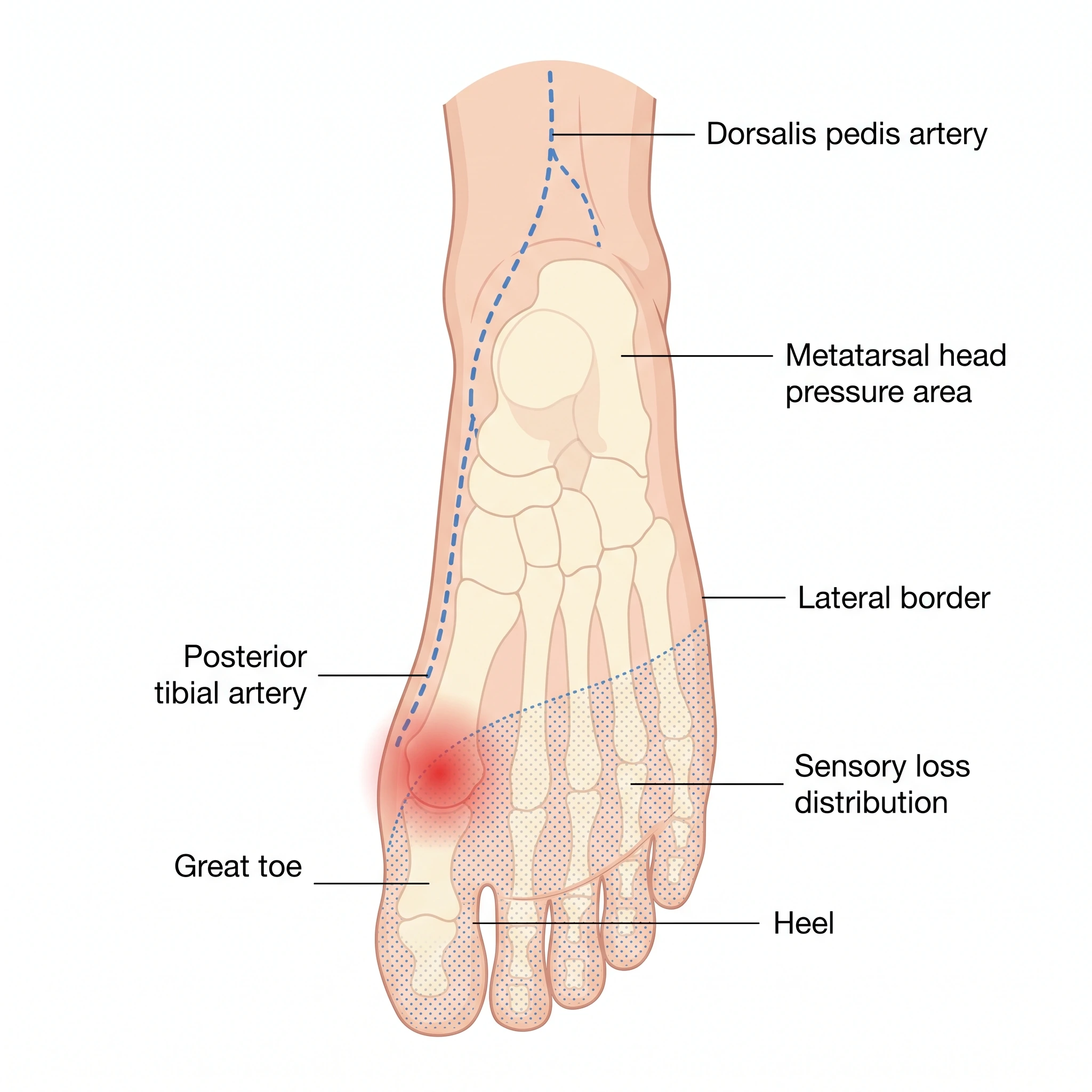
What losing protective sensation means in practice, how an ordinary blister turns serious, how to do the daily check properly including the sole and between every toe, why shoes are inspected before they go on, why nails are cut straight across, and why a corn plaster is dangerous.
Stephanie Tine diagnoses and treats diabetic foot / at-risk foot in Fort Lauderdale, from the first visit through recovery.
What does it mean to have lost protective sensation?
Pain is a warning system.
When a shoe rubs, a nerve in the skin sends a signal, and long before you think about it you shift your weight, loosen a lace, or take the shoe off. That reflex is called protective sensation.
Diabetes can damage the small nerves of the feet over years. The longest nerves are affected first, which is why the change starts at the toes and moves up. When enough of those nerves stop working, the warning system goes quiet. This is called loss of protective sensation, and it is not the same as feeling nothing at all. Many people can still feel a hand on the foot or the pressure of a sock, and conclude that their feeling is fine. What has gone is the finer alarm: the sharp, immediate signal that a small patch of skin is being damaged right now.
Two things make this hard to notice on your own. The loss is gradual, so there is no day when it happens. And the loss itself does not hurt, so nothing draws your attention to it.
Loss of protective sensation does not mean the foot is doomed. It means the job of watching the foot moves from the nerves to the eyes and the hands, and it now has to be done on purpose. Peripheral neuropathy covers the nerve condition itself in more detail.
How does an ordinary blister become a serious problem?
Follow the same blister through two different feet.
In a foot with normal feeling, a new shoe rubs the back of the heel. Within an hour it stings. You loosen the shoe, add a thicker sock, or change shoes. A small blister forms, it is sore for two days, and it heals.
In a foot that has lost protective sensation, nothing stings. The rubbing continues for the rest of the day. The blister forms and then tears open, because the walking never stopped. Now there is a patch of raw skin, and it is still being pressed and sheared with every step. Bacteria that live harmlessly on the surface of the skin reach the tissue underneath. Because a sock hides it and the foot does not complain, this can go on for days before anyone looks.
Two features of diabetes speed up what comes next. Reduced blood flow means immune cells and any antibiotics arrive in smaller numbers, and high blood sugar makes those cells work less well. On the foot there is also very little soft tissue between skin and the bones and tendons underneath, so an infection that gets past the skin has a short distance to travel.
None of this is a reason to be frightened of your feet. It is the reason a blister on a numb foot gets looked at within a day or two rather than watched for a week. What such a blister can become is described on diabetic foot ulcer.
How do I do the daily foot check properly?
Most people who say they check their feet are glancing at the tops.
The check that actually catches things takes about two minutes and covers the surfaces you cannot see while standing.
Do it at the same time every day. Bedtime works well, because marks a shoe made that day are still visible. Sit in good light and take off both socks.
Look at the top of each foot, then the sides, then the heel. Then the sole. The sole is where most wounds start and it is the part almost nobody sees. Use a mirror: a long handled mirror held under the foot, or a plain mirror laid flat on the floor with the foot held over it. A phone camera works just as well. Photograph each sole and look at the picture, which also gives you something to compare against next week.
Then the toes, one space at a time. Spread each pair apart and look into the space. There are four spaces on each foot. The space between the fourth and fifth toes is the one most often skipped and the one that most often turns soft, white, and cracked. Dry each space afterward.
Finally, feel. Run the back of your hand over both feet and compare them. A patch that is warmer than the same spot on the other foot is worth reporting even when there is nothing to see.
You are looking for redness that does not fade after a few minutes, a blister, a cut, a crack, a dark spot inside a callus, swelling on one side only, or a change in a nail. Anything you find gets called in rather than watched.
Why should I check inside my shoes before I put them on?
Because a foot that cannot feel a pebble will walk on it all day.
Small objects find their way into shoes constantly: gravel, a coin, a bead, a bottle cap. A sock can bunch under the arch. An insole can ruck up at the heel. A lining can tear and leave a stiff edge. A staple can work its way through the sole. Any one of these presses on a single point of skin for hours, and that is exactly how a wound starts.
The check takes about five seconds. Before each shoe goes on, put your hand into the toe box and sweep it around, then run your fingers along the insole and the inside of the heel. Do it by feel rather than by looking, because your hand finds a rough seam your eye misses.
Break new shoes in slowly, an hour or two on the first day, and check the skin as soon as they come off. A red mark still there ten minutes later means that shoe needs stretching or replacing before it is worn again. Keep two pairs in rotation so each has a day to dry, since damp shoes soften skin and soft skin tears.
Shoes and socks go on for every trip across the room, including the walk to the bathroom at night.
Why are toenails cut straight across?
A toenail cut in a curve, following the shape of the toe, leaves a small spike of nail buried at the corner.
As the nail grows forward, that spike is driven into the soft fold of skin beside it. The skin swells around it, and the nail edge ends up under the skin rather than over it. That is an ingrown toenail, and the shape of the cut is the most common reason it happens.
Cutting straight across leaves the corner where you can see it, sitting on top of the skin. Cut level with the tip of the toe, not shorter. Cut straight, in two or three small bites rather than one, so the nail does not split. Leave the corners alone. Smooth the corner with an emery board so it does not catch on a sock. Never dig down the side of the nail with the point of a clipper, and never use scissors, which twist the nail as they cut. Trim after a shower, when the nail is slightly softer, but not after a long soak, which leaves nails soft enough to tear.
There is an honest limit to this advice. If you cannot see your feet clearly, cannot reach them comfortably, have thick or curved nails, or have reduced feeling, home trimming is not worth the risk, and professional trimming becomes part of routine care. An ingrown toenail that has already formed on a foot with diabetes is treated rather than watched, and ingrown toenail removal is a short office procedure.
What should I do about a callus, and why is a corn plaster dangerous?
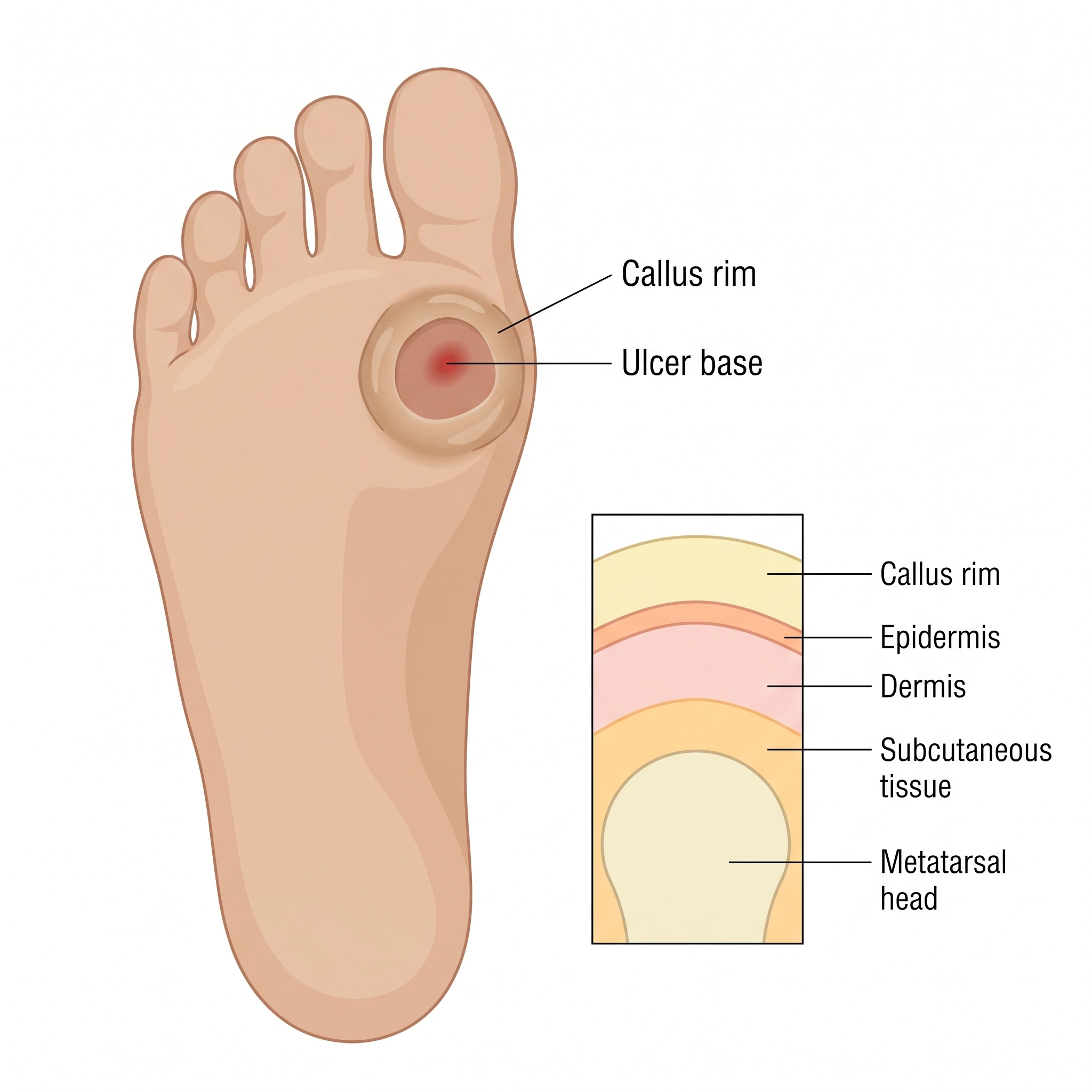
A callus is skin responding to repeated pressure, so it is a map of where the foot is loaded hardest.
It is also a problem of its own. Thick, stiff skin concentrates pressure rather than spreading it, so the callus raises the load on the tissue underneath. A dark red or brown spot inside a callus is bleeding beneath the skin, and it means the tissue under there is already damaged. On a foot with diabetes that finding is urgent, not cosmetic.
Do not take anything sharp to a callus yourself, and do not use a medicated corn or callus plaster.
A blade in your own hand, on a foot you cannot feel, has no feedback to stop it. People who try it go a layer too deep, and the wound that follows sits directly under the pressure point that built the callus.
Medicated plasters and corn removers work with an acid, usually salicylic acid, that dissolves skin. The acid cannot tell where the callus ends and living skin begins. On a foot with reduced feeling and reduced blood flow, that becomes a chemical burn that opens a wound while nobody feels it happen. The American Podiatric Medical Association advises people with diabetes against over the counter corn and callus removers for this reason.
Callus reduction in the office is quick and repeated as the callus rebuilds. The other half of the answer is finding the pressure and taking it away, which is the job of custom orthotics and protective footwear. More on the skin problem is on corns and calluses.
What does the annual foot exam find that I cannot?
Three things, mainly.
The first is a measurement of feeling. A thin nylon filament is pressed against several spots on the sole until it buckles. It delivers the same force every time, so it answers a question your own hands cannot: how much protective sensation is left, spot by spot. A tuning fork on the big toe checks vibration sense, which often fades first. It turns a vague sense that something is off into a documented finding.
The second is circulation. Pulses are felt on the top of the foot and behind the ankle. When they are hard to find, a blood pressure cuff at the ankle compares ankle pressure with arm pressure. Reduced flow changes how any future wound would be handled, and it is often silent. Peripheral arterial disease describes it in full.
The third is shape and pressure. Hammertoes, a collapsing arch, a bunion, a prominent bone under the ball of the foot, and the wear pattern of your shoes all show where the next problem is likely to be. A foot that has turned warm, swollen, and red without an injury is checked for Charcot foot, which is manageable early and hard to undo late.
Out of these comes a risk category, and the risk category sets the schedule. The American Diabetes Association recommends a comprehensive foot exam at least once a year for everyone with diabetes, with more frequent checks once neuropathy, poor circulation, deformity, or a previous wound is present. A page cannot tell you which category you fall into; the exam can.
What if I cannot see or reach my feet well?
This is common, and it is the point at which daily checks quietly stop happening.
Diabetes affects eyesight. Arthritis, back pain, weight, and stiff hips make bending to the sole hard. Living alone removes the person who would otherwise have noticed.
There are workarounds, and they work. The phone photograph described above solves reach and eyesight at once, and a cheap mirror laid flat on the floor needs no bending and no grip.
Ask someone. A partner, an adult child, or a home care aide can look the feet over once or twice a week even if you do the daily look yourself. Show them the sole, the heel, and every space between the toes.
Hand over the nails and calluses. If seeing or reaching is hard, home nail care is where injuries happen. Professional trimming is routine and quick, and the office answers coverage questions.
Attach the check to something you already do daily, such as taking your shoes off or brushing your teeth. Habits tied to an existing habit survive; habits that depend on remembering do not.
What are the treatment options?
- 01Daily foot check, daily moisturizer on the tops and soles with the toe spaces kept dry, anDaily foot check, daily moisturizer on the tops and soles with the toe spaces kept dry, and blood sugar management with your diabetes care team
- 02Shoes and socks for every step, indoors included, with the inside of each shoe checked byShoes and socks for every step, indoors included, with the inside of each shoe checked by hand first
- 03Professional nail and callus care instead of home tools when feeling, circulation, or reacProfessional nail and callus care instead of home tools when feeling, circulation, or reach is reduced
- 04A comprehensive foot exam at least once a year, and more often once neuropathy, poor circuA comprehensive foot exam at least once a year, and more often once neuropathy, poor circulation, deformity, or a healed wound is present
- 05Cushioned over the counter insoles and a roomy toe box for a foot with normal shapeCushioned over the counter insoles and a roomy toe box for a foot with normal shape
- 06Custom accommodative insoles and protective footwear for a foot with neuropathy, deformityCustom accommodative insoles and protective footwear for a foot with neuropathy, deformity, or a healed wound
- 07Prompt office treatment of any blister, callus, crack, or nail problemPrompt office treatment of any blister, callus, crack, or nail problem
- 08Vascular evaluation when pulses are weak or a wound is slow to closeVascular evaluation when pulses are weak or a wound is slow to close
- 09Surgery to correct a deformity that keeps producing pressure wounds despite footwearSurgery to correct a deformity that keeps producing pressure wounds despite footwear
What do patients ask most?
Is a salon pedicure safe if I have diabetes?+
Can I use a pumice stone?+
My feet get cold at night. Can I use a heating pad or a hot water bottle?+
My feeling is still normal. Do I really need all of this?+
Do dry, cracked heels count as a problem?+
Trained at Adventist Health White Memorial, Los Angeles (three-year foot and ankle surgical residency, Chief Resident). Sees patients in Fort Lauderdale.
About Dr. Tine →