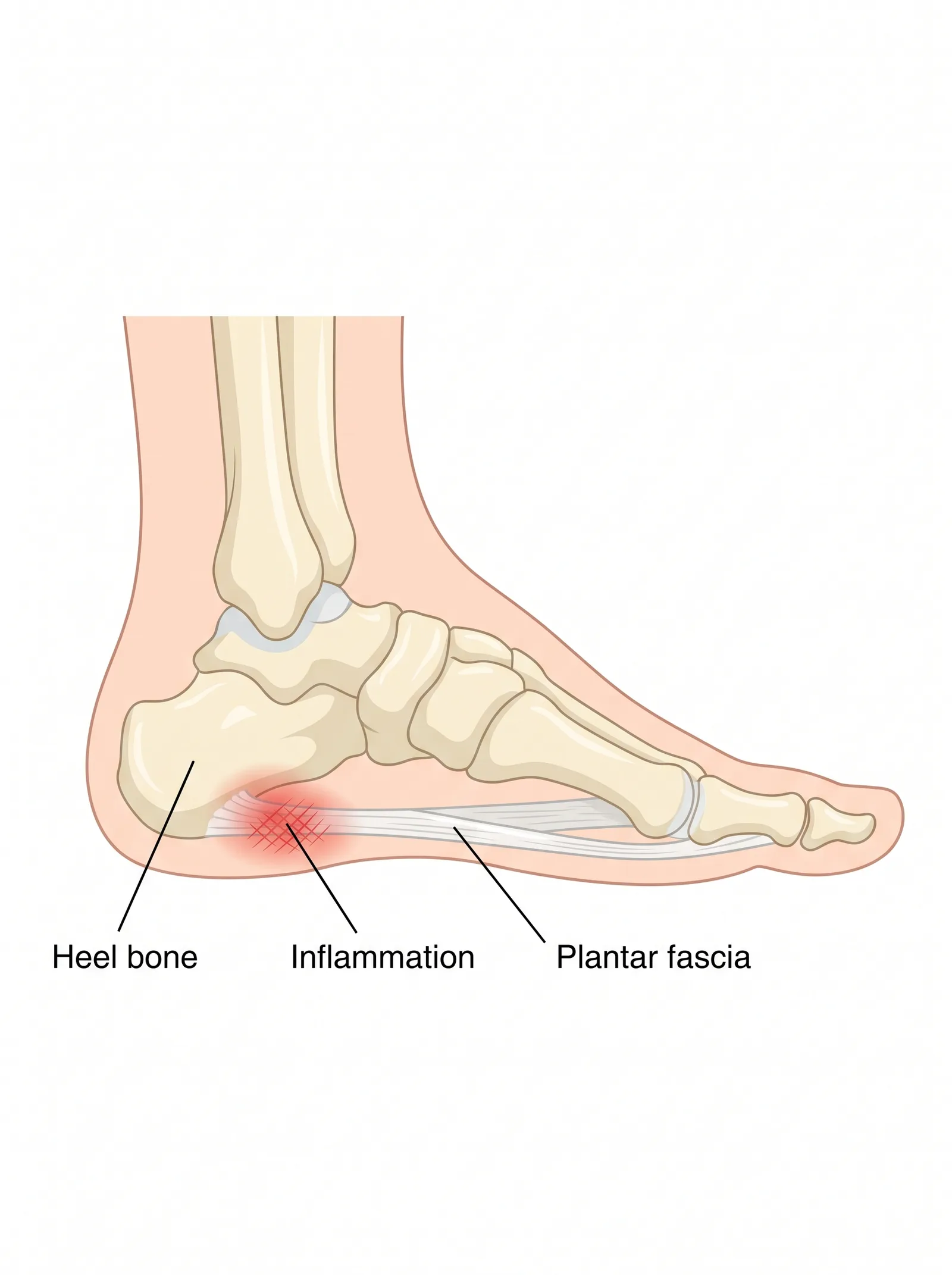
Plantar fasciitis is a common cause of heel pain from irritation of the plantar fascia, the thick band of tissue along the bottom of your foot. Dr. Tine evaluates plantar fasciitis in Fort Lauderdale and treats it, starting with stretching, orthotics, and other non-surgical care, and reserving surgery for the few cases that need it.
Stephanie Tine diagnoses and treats plantar fasciitis in Fort Lauderdale, from the first visit through recovery.
What is Plantar Fasciitis?
The plantar fascia is a thick band of tissue that runs from your heel to the base of your toes and supports the arch of your foot.
Plantar fasciitis is irritation and small tears in that band, usually where it attaches to the heel bone.
A common sign is sharp heel pain with your first steps in the morning or after sitting for a while. The pain often eases as you move, then returns after long standing or walking. It is common in runners, in people who stand all day, and in people with tight calf muscles or flat feet.
Plantar fasciitis is not dangerous, and most cases improve with simple care over weeks to months. The goal of treatment is to calm the irritation, restore flexibility, and support the arch so the tissue can heal.
How is Plantar Fasciitis diagnosed, and what does the visit involve?
Plantar fasciitis is usually diagnosed from your history and a physical exam.
Dr. Tine will ask where and when the pain occurs and press along the heel and arch to locate the tender point. Imaging is not always needed. An X-ray may be ordered to rule out other causes such as a stress fracture, and a heel spur seen on X-ray is a common finding that is often not the source of pain. Ultrasound or MRI is reserved for cases that do not follow the usual pattern.
What is recovery like for Plantar Fasciitis?
Most people with plantar fasciitis improve with consistent non-surgical care.
Meaningful relief is commonly reported over several weeks to a few months, according to general guidance from the American Academy of Orthopaedic Surgeons. These are ranges, not promises, and recovery depends on how long symptoms have been present and how consistently stretching and support are used. Surgery is rarely needed.
What are the treatment options?
- 01Rest, activity changes, and ice to calm the irritated tissueRest, activity changes, and ice to calm the irritated tissue
- 02Calf and plantar fascia stretching, often a key stepCalf and plantar fascia stretching, often a key step
- 03Supportive shoes and over-the-counter or custom orthotics, shoe inserts that support the aSupportive shoes and over-the-counter or custom orthotics, shoe inserts that support the arch
- 04Night splints that hold the foot in a gentle stretch during sleepNight splints that hold the foot in a gentle stretch during sleep
- 05Physical therapy to address tight muscles and mechanicsPhysical therapy to address tight muscles and mechanics
- 06Anti-inflammatory medicine when appropriateAnti-inflammatory medicine when appropriate
- 07Corticosteroid injection, an anti-inflammatory shot, in select casesCorticosteroid injection, an anti-inflammatory shot, in select cases
- 08Plantar fascia release, a surgery to relieve tension on the band, only for the small sharePlantar fascia release, a surgery to relieve tension on the band, only for the small share of cases that do not improve after months of non-surgical care
What do patients ask most?
Why does my heel hurt most in the morning?+
Will plantar fasciitis go away on its own?+
Do I need surgery for plantar fasciitis?+
Is a heel spur the cause of my pain?+
Trained at Adventist Health White Memorial, Los Angeles (three-year foot and ankle surgical residency, Chief Resident). Sees patients in Fort Lauderdale.
About Dr. Tine →