Heel pain has several causes and this guide separates them: plantar fasciitis, insertional Achilles pain, a heel stress fracture, a nerve problem, and in a child a growth plate irritation. It gives the pattern that tells them apart and is clear that a page cannot tell you which you have.
Stephanie Tine diagnoses and treats heel pain (symptom door) in Fort Lauderdale, from the first visit through recovery.
Questions patients ask
Can more than one thing be causing my heel pain at the same time?+
Should I stop running completely?+
Does it matter whether one heel hurts or both?+
How much should I read into a heel spur on an X-ray?+
Why is the first step out of bed the worst one?
The plantar fascia is a broad sheet of fibrous tissue running from the bottom of the heel bone to the base of the toes, working like a bowstring under the arch.
While you sleep, the foot rests with the toes pointed slightly down and the fascia settles into a shortened position. The first steps of the morning stretch it open all at once, and you feel that at the heel end, where the strain is highest.
That gives the problem a shape worth knowing. Sharp pain for the first ten or twenty steps, easing over a few minutes as the tissue loosens, then returning late in the day after hours of standing. Stand up after a long meeting and it bites again. Clinicians call this the start-up pattern, and describing it accurately does more of the diagnostic work than any test.
Now hold that against a different shape. Pain that is barely there at the start of a run, builds steadily until you have to stop, and aches for hours afterward is not behaving like a fascia. Tendons and bones behave like that. They hurt in proportion to the load you have just put through them, rather than hurting worst when cold.
There is a third shape: pain present at rest and at night, described as burning, tingling, or electric rather than sharp or bruised. That points away from overloaded tissue and toward an irritated nerve.
These are patterns, not proof. Many people have more than one thing going on at once. A page cannot tell you which of these you have. What it can do is give you the language to describe your pain precisely, which is most of the work at a first visit.
Does it matter exactly where on the heel it hurts?
It matters enormously.
The structures crowded into a small heel attach at different spots, and pressing on the right one is how most heel pain gets sorted.
Pain under the heel, slightly toward the inner edge, where the sole meets the curve of the heel bone, is the classic location for plantar fascia irritation. You can usually cover it with one fingertip. Pain at the very back of the heel, at the level of the bone where the Achilles tendon attaches, is a different problem and often comes with a firm bump that rubs on shoes. Pain a few finger widths higher, in the cord itself, is the mid part of that same tendon.
Pain that is deep and hard to point to, and that hurts when you squeeze the heel bone from both sides rather than when you press underneath, raises the possibility of a stress fracture in the heel bone.
Pain along the inside of the ankle just below the ankle bone, running forward into the arch with burning or numbness, follows the path of a nerve rather than the shape of the fascia. And in a growing child, pain at the back and sides of the heel that hurts when the heel is squeezed sideways usually comes from the growth plate rather than any adult structure.
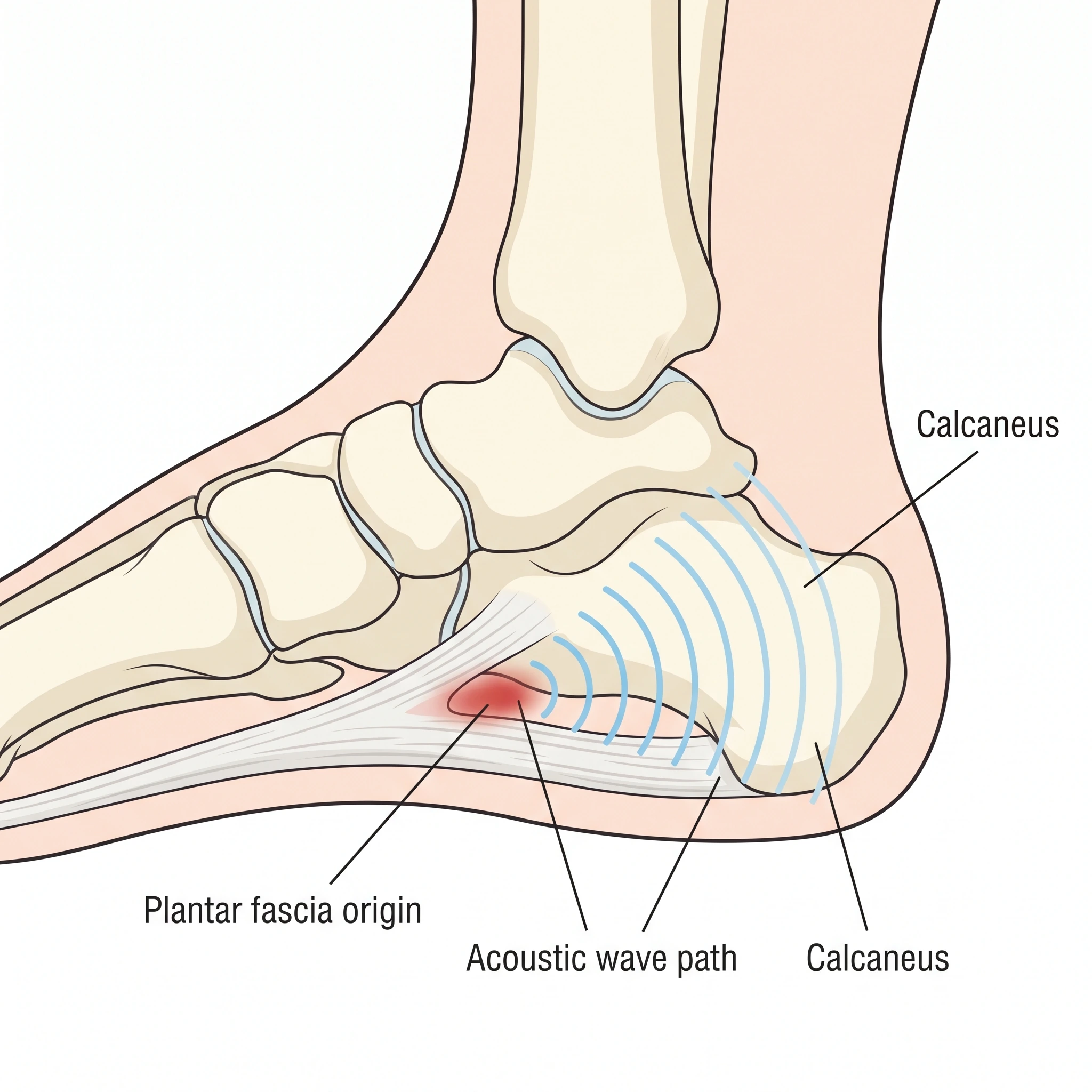
How is a heel stress fracture different from plantar fasciitis?
A stress fracture of the calcaneus, the heel bone, is a fine crack that develops when bone is loaded faster than it can rebuild.
It does not come from one injury. It comes from a change: a jump in mileage, a new job on concrete, a return to hiking after time off, or shoes with far less cushion than the last pair.
The pain behaves differently in three ways. It does not warm up; instead of easing after the first few minutes, it gets worse with each additional step and worse the longer you stay upright. It often aches at rest in the evening after a heavy day, which fascia pain usually does not. And it hurts when the heel bone is compressed from the sides, not only when the sole is pressed.
Timing matters for imaging. An X-ray in the first two or three weeks of a stress fracture is often completely normal, because the crack is too fine to show. Healing bone becomes visible later, so a repeat film weeks after the first can be more useful than the first one was. When the answer is needed sooner, an MRI shows swelling inside the bone before any crack appears.
The distinction has consequences. Stretching and arch support are reasonable for an irritated fascia and are not the answer for a cracked bone, which needs load taken off it for weeks. That is a main reason heel pain behaving oddly deserves an evaluation rather than another month of home care.
Could burning or tingling in my heel be a nerve problem?
Yes, and it is the cause most often missed, because it gets treated as stubborn plantar fasciitis for months before anyone reconsiders.
The tibial nerve runs behind the inner ankle bone through a tunnel of tissue and fans out into the sole. Compressed there, it produces burning, tingling, or numbness rather than sharp mechanical pain, a problem called tarsal tunnel syndrome. One of its branches, which supplies a small muscle deep in the arch, can be pinched close to the heel and cause pain in almost exactly the spot where fascia pain sits. That overlap is why the two are confused.
The clues that point toward a nerve are worth knowing. Symptoms present at rest and at night. Burning, pins and needles, or numbness rather than a bruised ache. Pain that spreads rather than staying under one fingertip. Tapping over the inner ankle sending a shock into the foot. And no response at all to weeks of stretching and support, when a fascia usually gives at least partial relief.
Nerve symptoms can also start above the foot. An irritated nerve root in the lower back can refer pain into the heel, and peripheral neuropathy can make both heels burn with nothing wrong in the foot itself. Sorting this out changes the plan, because nerve pain does not answer to arch support the way fascia pain does.
Why does my child have heel pain when adults have plantar fasciitis?
Because a growing heel has a structure an adult heel does not.
Until the early teens, the back of the heel bone carries a growth plate, a layer of cartilage where new bone is added, and the Achilles tendon pulls directly on it. Running and jumping on hard surfaces irritates that area. The condition is calcaneal apophysitis, also called Sever's disease, which is a misleading name because nothing is diseased and nothing is damaged permanently.
It looks different from adult heel pain in ways parents notice. It hurts at the back and sides of the heel rather than underneath. It is often in both heels. It flares during a sports season and settles during a break. The child limps after a game and is fine the next afternoon. Squeezing the heel from both sides recreates it, which is the usual test.
It clusters around a growth spurt, when the bones lengthen faster than the calf muscles stretch, so the tendon pulls harder on a growth plate already being asked to do a lot.
The reassuring part is that it resolves as the growth plate closes. The part that takes patience is that this can span a season or more, and the treatment in the meantime is calf stretching, heel cushions, sensible shoes, and managing how much running happens in a week rather than stopping sport.
What will the visit sort out, and what can it not?
The history does more of the work than most people expect: when it hurts, what it feels like, where you can point, what changed in the weeks before it started, and what you have already tried.
The examination then follows the map. Pressing along the inner heel where the fascia attaches. Pulling the big toe upward while pressing there, which tightens the fascia and often reproduces the pain. Feeling along the Achilles to see whether tenderness sits at the bone or in the cord. Squeezing the heel bone from the sides. Measuring how far the ankle bends with the knee straight and then bent, which separates a tight calf muscle from a tight tendon. Tapping over the nerve at the inner ankle. Watching you stand and walk, and looking at where your shoes are worn.
Imaging is added when the history asks for it, not routinely. An X-ray is reasonable when a fracture is possible or when weeks of correct care have not helped. Office ultrasound can show a thickened fascia or tendon. MRI is held back for cases not following the usual course.
What the visit cannot always do is produce one clean answer on day one. Heel pain frequently has two contributors, and a plan that treats the most likely one and is reassessed in a few weeks is more honest than a confident label. Dr. Tine will say which parts of the picture are solid and which are still being worked out.
How long should I give home care before being seen?
For a first episode with the classic morning pattern, several weeks of consistent home care is reasonable.
The word doing the work is consistent. Stretching twice on Tuesday and forgetting until Saturday is not a trial of treatment, and neither is wearing supportive shoes to work then standing barefoot on tile all evening.
A fair trial looks like this: calf and arch stretching before the first steps of every morning and again before bed, supportive shoes on from the moment you get up, indoors included, and a break from the activity that provokes it with something lower impact substituted. Give that a few weeks and most first episodes of fascia pain begin to move, according to general guidance from the American Podiatric Medical Association. These are ranges, not promises.
Some situations should not wait. Pain that started with a fall, a jump, or a sudden push-off. Pain getting worse with each step rather than easing. Swelling, warmth, or redness. Numbness, tingling, or burning. Heel pain in a child that causes a limp. And any heel pain in someone with diabetes, neuropathy, or circulation problems, where the usual advice about waiting does not apply.
If the pain has already lasted months under treatment, more of the same is unlikely to change the outcome. The useful question then is whether the target has been right all along.
Why did this start now when nothing changed?
Something almost always changed.
It is rarely the thing people think of first.
The common triggers are small and cumulative. A change of job or station that put you on concrete for eight hours instead of four. A move to hard floors from carpet. Shoes that finally wore out, since a heel counter and midsole collapse gradually and the day they stop supporting you does not announce itself. A new pair with a much lower heel than you are used to, which lengthens the calf and shifts load onto the heel. A change in body weight. A return to activity after illness.
Calf tightness deserves its own mention, because it is the most common mechanical contributor and the most easily missed. A tight calf limits how far the ankle bends. When the ankle cannot bend, the foot compensates by flattening and rolling inward through the step, which drags on the fascia and loads the heel. People with a tight calf usually have no symptoms in the calf at all.
Foot shape plays a part too. A flatfoot collapsing under load strains the fascia along its length, while a high, rigid arch delivers shock straight to the heel with no give. None of this is your fault. The point is that a heel settles fastest when the thing that started it is identified and changed, not only when the sore tissue downstream of it is treated.
Trained at Adventist Health White Memorial, Los Angeles (three-year foot and ankle surgical residency, Chief Resident). Sees patients in Fort Lauderdale.
About Dr. Tine →